
 Revenue Cycle Management Services
 Medical Billing Services
 Specialized Services
 Operational Finance
 Credentialing (CVO)
 Enrollment & Licensing
 Patient Access & Contact Center
 Authorization & Verification
 Neolytix Growth Services
 Payer Analytics & Contract Strategy
 Workforce & Recruitment
 The Full Lifecycle
 InCredibly
 Operational Dashboards & Reporting
 Integrated Partner Ecosystem
 Multi-Location & Specialty Groups
 Behavioral Health Organizations
 PE-Backed Platforms & MSOs
 FQHCs & Community Health
 Rural RHC


 How We Think / About
 Careers
 Articles
 Billing & Coding Guides
 Case Studies
 Events & Press
 Industry Reports & Benchmarks
 Testimonials

Behavioral Practice Health Marketing
You’ve been looking around lately and noticing that many practitioners like yourself have moved into solo practices in the face of greater commercialization of larger healthcare groups. The difference between them and you is that they seem to be prospering in spite of the difficulties of being a small practice and you’re still struggling to bring new patients in-house.
You’ve made it your mission to successfully operate as a small practice independent and out of the shadow of those Goliath healthcare groups, but you don’t have the marketing budget of those larger practices to compete. And it’s not that you’re looking to compete with them- not at all- you just want to know how they deploy their marketing practices so you could use it to benefit behavioral practice health marketing. So how do those other small practices market successfully?
First, let’s discuss the state of behavioral health practices since before COVID, which were experiencing a shortage especially in rural areas. Those who needed your services were having trouble finding them in their area. Then COVID hit and elevated levels of adverse mental health conditions, substance abuse, and suicidal ideation were reported by adults in the United States in June 2020. The prevalence of symptoms of anxiety disorder was approximately three times those reported in the second quarter of 2019 (25.5% versus 8.1%), and prevalence of depressive disorder was approximately four times that reported in the second quarter of 2019. Most reviewed studies reported negative psychological effects including post-traumatic stress symptoms, confusion, and anger. Stressors included longer quarantine duration, infection fears, frustration, boredom, inadequate supplies, inadequate information, financial loss, and stigma.
Bottom line? Your community desperately needs you right now.
And they aren’t going to understand the reason they can’t find you is because you don’t know how to leverage your online presence to find them. The responsibility of finding those hurting and in need of your services falls on you. That’s a problem you’ll want to figure out pretty fast because everyday people are falling more and more into grief and depression. It’s your calling to help them. It’s why you ventured into starting your small practice in the first place. You don’t have responsibility to your patients- you have an obligation to serve them. Because no one else can give them the healing you can.

This is why other small practices are winning right now.
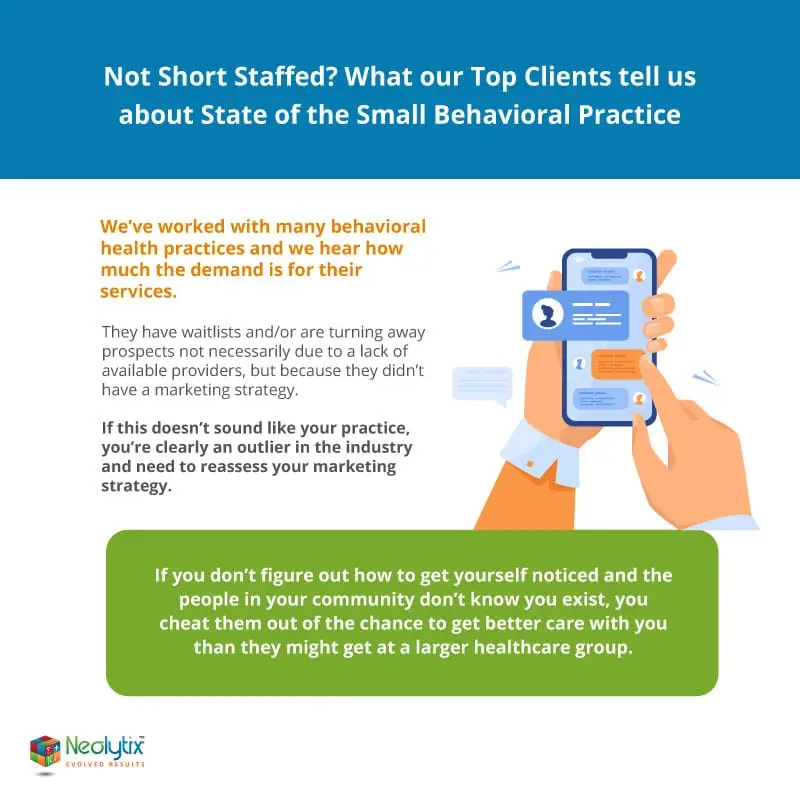
We’ve worked with many behavioral health practices and we hear how much the demand is for their services. They have waitlists and/or are turning away prospects (the former being a practice that can lead to detrimental outcomes) not necessarily due to a lack of available providers, but because they didn’t have a marketing strategy. Once we worked with them and showed them how to make their website work for them, they started shifting into developing a system to handle the influx of new patient prospects. If this doesn’t sound like your practice, you’re clearly an outlier in the industry and need to reassess your marketing strategy.
Your belief system about your practice’s mission is directly tied to its success (or failure).
You already believe that a small, intimate practice fosters the most trust in patients. It’s what allows them to feel comfortable with you. It’s what drives them to tell their friends and family about you. Forming small doctor/patient relationships is the best way to have the word about your behavioral health practice spread throughout the community. Word of mouth is still the best form of marketing. Unfortunately, you can’t scale that too much because you’re only one person who can only see a certain number of patients daily. You need another marketing leg to help you bring patients in the doors without you needing to be present 24/7.
Building a relationship with your community is how you create generational patients.
You’ve known for some time now that a community is stronger when it has strong bonds with its healthcare provider. People want to connect with each other. As a smaller practice, you have the advantage over larger healthcare groups who can’t afford the time it takes to sit with a patient and listen to their needs. Quality, detailed care is what separates you from the bigger guys. It’s what has your patients bringing in their children and their children’s children.
This isn’t a number’s game to you. It’s quality care and posterity healing. It’s your life’s work and it’s your need to want to create a haven of safety for families who don’t know what to do or whom to trust when they get sick. You’re not just building a behavioral healthcare practice, you’re building a sanctuary for future generations. And that’s not something that those larger healthcare groups can compete with. This is what differentiates you from them.
What happens to your community and patients if you don’t figure out your marketing?
If you don’t figure out how to get yourself noticed and the people in your community don’t know you exist, you cheat them out of the chance to get better care with you than they might get at a larger healthcare group. At the very least, they certainly wouldn’t get as good quality one-on-one care with them as they would with you. That translates to patients feeling more fear about their illnesses, more uncertainty about who to trust as their provider and certainly more frustration and feelings of helplessness when they can’t control how to heal themselves.
So how do you get noticed?
Are you starting to understand the significance that a competent marketing strategy plays in your practice? Do you see how vital it is for the future of your practice and how it can protect you from the pressure of those larger healthcare groups? It’s a non-negotiable factor to any successful practice.
As I mentioned earlier, word of mouth marketing is still the most common and effective form of marketing but it shouldn’t be the only type you rely on. There are other ways to set up a system and have it work for you 24/7. For starters, a quality web presence should be part of any behavioral health practice’s growth strategy. This includes a custom-built website design that is fully optimized for organic SEO.
Paid advertising is also a useful tool as nearly half of given households have a family member that has sought treatment from a mental health professional. The key is to connect with those patients while they are actively searching for you.
There are other methods, but none of them will work if you don’t know what you’re doing. And if you don’t have any background knowledge in marketing, the time it will take you to get up to speed is too costly when you’re trying to focus on building your practice. That’s why you should talk to us. We customize a marketing strategy specifically for your behavioral healthcare practice and set up a system that attracts new patients to you. That means you don’t have to chase new prospects. We build it and they come to you.
Interested in learning more about how Practice Tech Solutions can help? Reach out here and let’s talk about it.
Because you want to make a difference and you aren’t going to let what you don’t know get in the way of that.
