


Most practices that believe in-house billing is the cheaper option have not run the full numbers.
They see a billing coordinator’s salary and compare it to a vendor’s percentage fee. That comparison misses at least half the actual cost. When you account for benefits, software licensing, clearinghouse fees, ongoing training, turnover replacement, and the revenue impact of avoidable denials, in-house billing consistently costs more than practices estimate — and performs below what a well-run outsourced operation delivers.
This is not an argument that outsourcing is always the right answer. There are practice types and operating situations where in-house billing makes sense. But the decision should be made with accurate cost data on both sides, not assumptions.
What In-House Medical Billing Actually Costs
In-house billing means your practice employs its own billing staff, maintains its own billing technology, and manages the full revenue cycle internally. The perceived advantage is control and visibility. The underestimated reality is total cost of ownership.
Staffing
Staffing is the most visible line item, and the one most frequently underestimated. A medical billing coordinator earns an average of $38,000 to $48,000 annually in base salary. A credentialed medical coder earns $45,000 to $60,000. For a small practice with two billing staff, base salary alone runs $80,000 to $110,000 per year.
That figure does not include the true cost of employment. When you add employer payroll taxes, health insurance contributions, paid time off, retirement plan contributions, and workers’ compensation, total employment cost typically runs 25% to 35% above base salary. A $45,000 billing coordinator costs $56,000 to $61,000 in total compensation.
Turnover compounds this. Medical billing departments experience above-average turnover relative to other administrative roles. When a biller leaves, the practice absorbs recruitment costs, onboarding time, and a productivity gap that typically runs 16 to 22 weeks before a replacement reaches full efficiency. During that gap, claim submission slows, denials accumulate, and AR ages — none of which shows up in the salary line.
Technology
In-house billing requires dedicated billing software, clearinghouse access, and EHR integration. Annual software licensing for a small to mid-size practice runs $12,000 to $40,000, depending on platform. Clearinghouse fees add another $3,000 to $8,000 annually for typical claim volumes. IT support, system updates, and cybersecurity infrastructure — increasingly non-negotiable under HIPAA — add further cost that practices often attribute to general overhead rather than billing operations.
Software also requires ongoing configuration as payer rules, code sets, and compliance requirements change. Someone on staff needs to manage those updates, either as a dedicated function or as an additional burden on billing coordinators who are already managing claims.
Training
ICD-10 and CPT code sets are updated annually. Payer-specific billing rules change throughout the year. Medicare and Medicaid policy updates require continuous recalibration of billing workflows. Keeping an in-house team current requires structured, ongoing training investment — typically $2,000 to $5,000 per biller per year when you account for continuing education, certification maintenance, and time off-production for training.
The Revenue Cost of In-House Performance Gaps
The most significant cost of in-house billing is not on the expense side — it is on the revenue side. In-house billing operations at small to mid-size practices commonly run denial rates of 8% to 12% and clean claim rates well below the 95% industry benchmark. The administrative cost to rework a denied claim averages $57 per denial. Claims that are never reworked — research consistently shows 35% to 60% of denied claims are never resubmitted — represent permanent revenue loss.
Industry data puts the average cost-to-collect for in-house billing at 13.7% of net collections, factoring in all staffing, technology, and rework costs. For a practice collecting $2 million annually, that is $274,000 in total billing overhead — a figure most practices never calculate because the costs are distributed across multiple budget lines.
What Outsourced Medical Billing Services Actually Cost
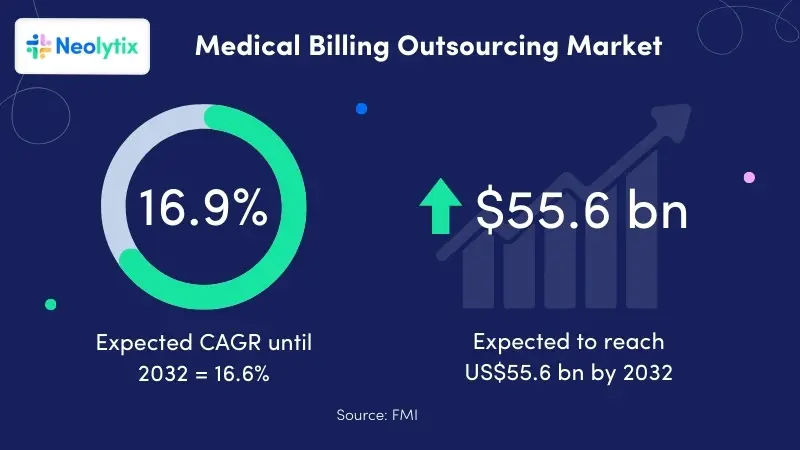
Outsourced medical billing services are most commonly priced as a percentage of monthly collections, typically ranging from 4% to 9% depending on specialty complexity, claim volume, and scope of services. A general primary care practice might pay 4% to 6%. A specialty practice with complex coding, frequent prior authorization requirements, or high-acuity procedure mix typically falls in the 6% to 8% range.
At face value, this is the number most practices compare to their salary line. That comparison understates the value of the outsourcing model in two important ways.
First, the percentage fee replaces not just salary but the full cost of employment, software, training, clearinghouse fees, and IT infrastructure. The outsourced vendor absorbs all of those costs within their fee structure. Second, a well-performing outsourced billing operation improves collection performance — meaning the base revenue figure on which that percentage is calculated grows, often offsetting a meaningful portion of the fee itself.
Industry data puts the average cost-to-collect for outsourced billing at 5.4% of net collections — less than half the in-house benchmark of 13.7%. That differential is what makes the math work for most practices.
What the Fee Should Include
Not all outsourced billing fees are structured identically. Before comparing vendors on headline rate, confirm what is included. A full-service engagement should cover eligibility verification, charge entry, claim scrubbing, claim submission, payment posting, denial management and appeals, AR follow-up, patient statement generation, and performance reporting. Credentialing support, prior authorization management, and coding audit services are sometimes bundled and sometimes scoped separately.
Get itemized clarity in writing. A vendor quoting 5% with denial management excluded is not cheaper than a vendor quoting 6% with it included — they are different scopes of service.
- Neolytix • Medical Billing
Medical Billing
Side-by-Side Cost Comparison
The table below illustrates the cost structure for a hypothetical small practice with two providers and approximately $1.5 million in annual collections.
Cost Category | In-House Billing | Outsourced Billing |
Staffing (base salaries, 2 billers) | $90,000 – $110,000 | Included in service fee |
Benefits & payroll taxes (~30%) | $27,000 – $33,000 | Included in service fee |
Billing software & clearinghouse fees | $15,000 – $48,000 | Included in service fee |
Training & certification | $4,000 – $10,000 | Included in service fee |
Revenue loss from denial gaps (est. 5% of collections) | $75,000 | Largely avoided — higher clean claim rates |
Service fee (6% of $1.5M collections) | — | $90,000 |
Revenue improvement from higher clean claim rates (est. 3% lift) | — | +$45,000 recovered |
Total estimated annual cost | $211,000 – $276,000 | ~$45,000 net effective cost |
The gap is significant, and it widens for practices with higher denial rates, above-average turnover, or specialty billing complexity that their current staff is not equipped to handle.
The Hidden Costs Most Practices Overlook
Beyond the direct comparison, several cost categories routinely go uncounted in in-house billing evaluations.
Provider time on billing oversight. In practices without a dedicated billing manager, physicians and practice administrators spend meaningful time resolving billing issues, answering payer questions, and managing staff performance. That time has an opportunity cost — typically valued at the provider’s hourly rate. Even two hours per week per provider adds up quickly across a year.
Compliance exposure. In-house billing teams managing high claim volumes without structured audit programs carry compliance risk that does not appear on any line item until it becomes an enforcement action. The federal government recovered $5.7 billion through False Claims Act enforcement in fiscal year 2025, with healthcare accounting for the largest share. A billing audit that surfaces upcoding or documentation mismatches can cost a practice $10,000 to $50,000 in remediation, independent of any penalties.
Cash flow delay. Practices with in-house billing backlogs experience delayed claim submission that extends AR aging from day one. Claims that should be submitted within 24 hours of an encounter frequently take 48 to 72 hours in manual workflows. At scale, that delay compounds into meaningful cash flow disruption — particularly for practices with thin operating margins.
Technology debt. Billing software that is not regularly updated falls out of compliance with payer system requirements and HIPAA security standards. Practices that defer technology investment to reduce overhead often face larger remediation costs when they eventually address the gap.
When In-House Billing Makes Sense
Outsourcing is not the right model for every practice. In-house billing makes sense when:
Your practice is large enough to support a dedicated, experienced billing team with a billing manager overseeing performance, structured audit processes, and continuous training programs. Large health systems and hospital groups that process very high claim volumes can sometimes achieve competitive cost-to-collect ratios through economies of internal scale.
You have specialty billing complexity that requires tight integration with clinical workflows, and you have successfully built internal expertise around that complexity. Some surgical specialties, for example, benefit from billing coordinators who work directly alongside clinical staff on documentation and charge capture.
You have existing staff with strong performance metrics — clean claim rates at or above 95%, denial rates below 5%, and AR consistently under 40 days — and the cost of transition would exceed the performance benefit.
If your in-house operation meets those benchmarks and the cost math works, staying in-house is a defensible decision. The issue is that most practices that want to stay in-house cannot confirm those metrics because their current billing operation lacks the reporting infrastructure to produce them.
When Outsourcing Delivers the Clearest Return
Outsourced medical billing services consistently outperform in-house operations when one or more of these conditions are present:
Your practice cannot confirm its current clean claim rate, denial rate, or days in AR — meaning you are making a retention decision without performance data. Your denial rate is above 5% or your AR is consistently aging past 45 days. Your billing staff turnover has been disruptive in the past 12 to 18 months, creating coverage gaps and institutional knowledge loss. You are expanding — adding providers, opening new locations, or adding a new specialty — and your billing infrastructure cannot scale proportionally. Your specialty billing complexity has increased and your current team was not hired with that complexity in mind. You are spending provider or administrator time managing billing operations rather than clinical and strategic priorities.
For practices in any of these situations, the cost of continuing in-house billing is measurably higher than the cost of a quality outsourcing engagement — even before accounting for the revenue improvement that a well-performing billing partner typically delivers.
How to Make the Decision
If you are working through this decision for your practice, the most useful starting point is an honest assessment of your current billing performance. Before comparing costs, confirm your actual metrics.
Pull your clean claim rate for the last 90 days. Calculate your average days in AR by payer. Identify your top five denial reason codes and what percentage of those denials were ultimately collected. Calculate your net collection rate across the same period. If you cannot produce that data, that itself is a meaningful finding — and a strong argument for at minimum an external billing audit before making any structural decision.
Once you have current performance data, calculate your true in-house cost using the framework above. Include all staffing costs at full employment cost, all technology costs, training, and a conservative estimate of revenue leakage from your current denial rate. Then get specific pricing from two to three outsourced billing vendors, with full scope defined in writing.
Compare the two figures. For most small to mid-size practices, the math favors outsourcing. For larger, well-resourced practices with demonstrated strong performance, the case is less clear-cut and the decision often comes down to strategic preference as much as cost.
What Neolytix Brings to This Decision
With over 14 years supporting healthcare organizations across the revenue cycle, Neolytix has worked with practices at every stage of this evaluation — from practices running their first billing audit to those transitioning from a previous outsourcing partner that underperformed.
Our medical billing services operate on a full-cycle model: eligibility verification, clean claim submission, denial management, AR follow-up, and performance reporting tied to defined KPIs. Clients receive dedicated account management and reporting visibility that most in-house operations cannot match. Every engagement operates under HIPAA safeguards and ISO 27001-certified security practices.
If you are working through the in-house versus outsourced decision and want a clear-eyed look at what your current billing operation is actually costing you, schedule a consultation with our team.
Conclusion
The in-house versus outsourced billing decision comes down to one question that most practices have not answered accurately: what does your current billing operation actually cost, and what is it actually delivering?
When practices run that calculation with full cost accounting — staffing at true employment cost, technology, training, and a realistic estimate of revenue impact from denial and clean claim performance — the in-house model is more expensive than it appears for the majority of small to mid-size practices. Outsourced medical billing services, priced at 4% to 9% of collections and covering all technology and staffing overhead, typically deliver better economics and better revenue cycle performance simultaneously.
That is not a universal rule. It is a starting point for an honest, data-driven evaluation — which is the only reliable basis for making the right call.
- Neolytix • Contact Us
Schedule a Consultation
Neolytix partners with healthcare organizations across revenue cycle, credentialing, and administrative operations ,14+ years of expertise and AI-enabled automation to reduce inefficiencies and drive sustainable growth.