


- Contact Us +1 224 529 4400
- Schedule A Free Consultation
Radiology is the sharp-eyed detective of modern healthcare, sniffing out diagnoses and mapping out treatment plans with pinpoint precision. But when it comes to billing? It’s less Sherlock Holmes and more sudoku with legal consequences.
Coding for radiology isn’t just about knowing CPT, ICD-10-CM, and HCPCS codes, it’s about documenting every detail with surgical accuracy. Miss a step, and you could be looking at claim denials,a compliance headaches, and vanishing revenue.
- Neolytix • Medical Billing
Medical Billing
Why Radiology Coding Matters in 2026
Radiology sits at the heart of healthcare diagnostics, but getting reimbursed for those high-tech scans? That’s where the real challenge kicks in.
With coding guidelines tightening and audits lurking around every corner, accurate radiology coding is more crucial than ever. Think of it as the bridge between life-saving diagnostics and keeping your revenue cycle alive.

Poor documentation is one of the top reasons radiology claims get denied. The fix? Tight, thorough, and coder-friendly notes. Your future self and your bottom line will thank you.

⚡ Radiology CPT Codes Quick-Reference Cheat Sheet (2026)
The most frequently billed radiology CPT codes organized by imaging modality. Full documentation requirements and billing rules are in each section below.
Plain Film X-Ray
| CPT | Service | Key Rule |
|---|---|---|
| 71045 | Chest X-ray, 1 view | Document clinical indication and view obtained |
| 71046 | Chest X-ray, 2 views (PA + lateral) | Most common chest X-ray code |
| 71048 | Chest X-ray, 4+ views | Requires documentation of each view |
| 73030 | X-ray shoulder, minimum 2 views | Specify laterality (LT/RT modifier) |
| 73562 | X-ray knee, 3 views | Specify laterality |
CT Scan
| CPT | Service | Contrast Status |
|---|---|---|
| 70450 | CT head/brain | Without contrast |
| 70470 | CT head/brain | With and without contrast |
| 74177 | CT abdomen and pelvis | With contrast — highest volume abdominal CT |
| 71260 | CT thorax | With contrast |
| 72131 | CT lumbar spine | Without contrast |
MRI
| CPT | Service | Notes |
|---|---|---|
| 70553 | MRI brain, with and without contrast | MS follow-up, tumor eval; Mod –26 if interpretation only |
| 72148 | MRI lumbar spine, without contrast | Most common spine MRI |
| 72158 | MRI lumbar spine, with and without contrast | Post-surgical or neoplasm evaluation |
| 73721 | MRI joint, lower extremity, without contrast | Knee/ankle; specify laterality |
| 73223 | MRI joint, upper extremity, with and without contrast | Shoulder/wrist complex lesion |
Ultrasound, Nuclear Medicine & Mammography
| CPT | Service | Key Rule |
|---|---|---|
| 76700 | Abdominal ultrasound, complete | Must image all required abdominal organs; document limited if incomplete |
| 76856 | Pelvic ultrasound, complete | Transabdominal; document uterus, ovaries, bladder |
| 77067 | Screening mammography, bilateral | Preventive; no symptoms required; Z12.31 ICD-10 |
| 77066 | Diagnostic mammography, bilateral | Symptom-driven or abnormal screening follow-up |
| 78816 | PET scan, whole body | Prior auth universally required; A9552 for FDG drug separately |
| 78452 | Myocardial perfusion, multiple studies | Stress + rest protocol; prior auth required |
What Is Included in a Radiology Procedure and Coding Evaluation?
Radiology coding is about more than assigning codes, it’s decoding a patient’s medical story through images, reports, and just the right amount of acronyms. Whether it’s a routine chest X-ray or an intricate nuclear scan, each procedure must be backed by solid documentation and coded to perfection.
Precision in Documentation and Coding
Radiology covers a huge range of diagnostic and interventional services, each requiring its own billing finesse. Documenting the right details ensures medical necessity, cleaner claims, and fewer reimbursement hiccups.
Here’s what a strong radiology coding evaluation should include:
Patient History and Clinical Indications
The story starts here: symptoms, past imaging, and relevant health conditions.
This information supports the medical necessity of the radiology procedure and must be clearly reflected in the patient’s record.
Imaging Modality Selection
Radiologists don’t pick tools at random. Each modality comes with its own code (and billing landmines):
Imaging Modality Selection
Used for evaluating fractures, infections, and chest abnormalities.
Computed Tomography (CT)
Picture Provides detailed cross-sectional imaging for trauma, cancer screening, and organ evaluation.
Magnetic Resonance Imaging (MRI)
Used for soft tissue evaluation, neurological conditions, and musculoskeletal injuries.
Ultrasound
Frequently used in obstetrics, vascular studies, and soft tissue imaging.
Nuclear Medicine (PET, SPECT, and Bone Scans)
Assists in functional imaging for oncology, cardiology, and neurology.
Clinical Decision-Making and Report Documentation
Radiologists are storytellers in scrubs. Their reports translate grayscale pixels into life-altering insight. Here’s what needs to be in the report:
- Findings and interpretation of the imaging results.
- Recommendations for further studies if needed.
- Correlation with clinical findings.
- Documentation of contrast use, laterality, and specific anatomical details.
Accurate documentation ensures proper reimbursement and supports medical necessity for any follow-up imaging.
Did you know that radiology coding requires detailed knowledge of both CPT and ICD-10 codes?
Accurate coding is essential for proper reimbursement and compliance with healthcare regulations
CMS Billing Guidelines: Modifier 26, TC, and Global Billing
The Modifier 26 / TC framework is the single most important concept in radiology billing. Incorrect application of these modifiers is the leading cause of radiology claim denials. CMS billing guidelines define three billing scenarios for imaging services:
| Billing Scenario | Modifier | Who Bills | What’s Included |
|---|---|---|---|
| Practice owns equipment AND physician interprets | None (Global) | Practice bills globally | Full fee schedule — both TC and professional component bundled |
| Physician interprets only; hospital/facility owns equipment | –26 | Radiologist/physician | Professional component only (interpretation + written report) |
| Practice owns equipment; no physician interpretation on this claim | –TC | Facility/imaging center | Technical component only (equipment, film, technologist) |
Critical Compliance Rule
You cannot bill both the global code AND a –26 or –TC modifier for the same service on the same claim. If a physician at a hospital interprets an MRI, the hospital bills the TC and the physician’s group bills –26. Billing the global code when you only provided the professional component is a documented OIG overpayment pattern.
Multiple Procedure Reduction — Imaging
When multiple imaging studies are billed for the same patient on the same date, CMS applies the Multiple Procedure Payment Reduction (MPPR) to the professional component of subsequent studies. The first study is paid at 100% of the fee schedule; the second and subsequent professional-component interpretations are reduced to 75%. The technical component is not subject to MPPR for most imaging families. Document each study independently — separate orders, separate reports, separate medical necessity.
Supervision Levels for Radiology (CMS)
| Supervision Level | Definition | Common Radiology Application |
|---|---|---|
| General Supervision | Procedure performed under physician’s overall direction; physician need not be present | Routine X-ray, standard CT/MRI in hospital outpatient or imaging center |
| Direct Supervision | Physician must be immediately available in the office suite | Contrast-enhanced studies, fluoroscopy, ultrasound procedures |
| Personal Supervision | Physician must be physically present in the room during the procedure | Interventional procedures, biopsies, angiography |
Plain Film X-Ray CPT Codes
Plain film radiography (X-ray) codes are among the highest-volume, lowest-complexity codes in radiology billing. Despite their simplicity, denials occur when the number of views is underdocumented, laterality is missing for extremity X-rays, or the clinical indication doesn’t support the number of views billed.
Chest X-Ray
| CPT | Description | Common Use |
|---|---|---|
| 71045 | Chest X-ray, single view | Rapid screening, ICU portable, trauma |
| 71046 | Chest X-ray, 2 views (PA + lateral) | Standard outpatient chest; most commonly billed chest X-ray code |
| 71047 | Chest X-ray, 3 views | Add oblique or decubitus for pneumothorax, rib fractures |
| 71048 | Chest X-ray, 4 or more views | Complex evaluation; each view must be documented |
Spine X-Rays
| CPT | Description |
|---|---|
| 72020 | X-ray spine, single view |
| 72040 | X-ray cervical spine, 2–3 views |
| 72050 | X-ray cervical spine, 4–5 views |
| 72052 | X-ray cervical spine, 6 or more views (with flexion/extension) |
| 72100 | X-ray lumbar spine, 2–3 views |
| 72110 | X-ray lumbar spine, minimum 4 views |
Extremity X-Rays (Laterality Required)
| CPT | Description | Modifier Required |
|---|---|---|
| 73030 | X-ray shoulder, minimum 2 views | –LT or –RT |
| 73100 | X-ray wrist, 2 views | –LT or –RT |
| 73110 | X-ray wrist, minimum 3 views | –LT or –RT |
| 73130 | X-ray hand, minimum 3 views | –LT or –RT |
| 73560 | X-ray knee, 1–2 views | –LT or –RT |
| 73562 | X-ray knee, 3 views | –LT or –RT |
| 73600 | X-ray ankle, 2 views | –LT or –RT |
| 73610 | X-ray ankle, minimum 3 views | –LT or –RT |
Laterality Documentation:
For all unilateral extremity X-rays, failure to append –LT or –RT results in automatic payer rejection at most commercial payers and Medicare. The body part documented in the radiology report must match the modifier on the claim. Bilateral studies use Modifier –50 and are reimbursed at 150% of the unilateral rate (50% reduction applied to the second side).
CT Scan CPT Codes
CT scan coding is organized by body region and contrast status. The three contrast options — without contrast, with contrast, and with-and-without contrast — are separate CPT codes and must reflect what was actually administered. Upcoding from a without-contrast study to a with-contrast code is an audit red flag.
CT Head / Brain
| CPT | Contrast | Clinical Use |
|---|---|---|
| 70450 | Without contrast | Acute stroke, trauma, headache, hemorrhage — first-line urgent CT |
| 70460 | With contrast | Post-op, suspected mass, active inflammation |
| 70470 | With and without contrast | Complex lesion characterization, metastatic disease |
CT Thorax (Chest)
| CPT | Contrast | Clinical Use |
|---|---|---|
| 71250 | Without contrast | Lung nodule follow-up, COPD, emphysema staging |
| 71260 | With contrast | Pulmonary embolism (PE) protocol, lymphoma staging |
| 71270 | With and without contrast | Vascular and parenchymal evaluation together |
CT Abdomen & Pelvis
| CPT | Description | Notes |
|---|---|---|
| 74150 | CT abdomen, without contrast | Kidney stones, appendicitis screening |
| 74160 | CT abdomen, with contrast | Liver, spleen, pancreas evaluation |
| 74177 | CT abdomen and pelvis, with contrast | Highest-volume combined abdominal/pelvic CT; oncology staging, acute abdomen |
| 74178 | CT abdomen and pelvis, with and without contrast | Vascular and solid organ complex evaluation |
CT Spine
| CPT | Region |
|---|---|
| 72125 | CT cervical spine, without contrast |
| 72128 | CT thoracic spine, without contrast |
| 72131 | CT lumbar spine, without contrast |
| 72133 | CT lumbar spine, with and without contrast |
CT Colonography
CPT 74263 (CT colonography, screening) and 74261 (diagnostic, without contrast) are separately coded from standard abdominal CT. Medicare covers screening CT colonography (74263) as a colorectal cancer screening benefit. Do not bill 74261/74263 on the same date as a diagnostic colonoscopy — NCCI bundles these.
MRI CPT Codes
MRI coding follows the same contrast-status structure as CT but has additional complexity around joint laterality and spinal level specificity. MRI interpretation requires a signed, narrative radiology report — template-generated reports without individualized findings are a documented audit target for Medicare RAC auditors.
MRI Brain
| CPT | Contrast | Common Indications |
|---|---|---|
| 70551 | Without contrast | Seizure, structural evaluation, dementia workup |
| 70552 | With contrast | Infection, meningitis, active inflammation |
| 70553 | With and without contrast | MS lesion evaluation, tumor characterization, post-op follow-up |
MRI Spine
| CPT | Region | Contrast |
|---|---|---|
| 72141 | Cervical spine | Without contrast |
| 72156 | Cervical spine | With and without contrast |
| 72146 | Thoracic spine | Without contrast |
| 72157 | Thoracic spine | With and without contrast |
| 72148 | Lumbar spine | Without contrast — most commonly billed spine MRI |
| 72158 | Lumbar spine | With and without contrast — post-surgical or tumor |
MRI Joints (Laterality Required)
| CPT | Description | Modifier |
|---|---|---|
| 73221 | MRI joint, upper extremity (shoulder/elbow/wrist), without contrast | –LT or –RT required |
| 73223 | MRI joint, upper extremity, with and without contrast | –LT or –RT required |
| 73721 | MRI joint, lower extremity (hip/knee/ankle), without contrast | –LT or –RT required |
| 73723 | MRI joint, lower extremity, with and without contrast | –LT or –RT required |
MRI Abdomen & Pelvis
| CPT | Description |
|---|---|
| 74181 | MRI abdomen, without contrast |
| 74183 | MRI abdomen, with and without contrast — liver lesion characterization, MRCP |
| 72195 | MRI pelvis, without contrast |
| 72197 | MRI pelvis, with and without contrast — prostate, uterine, rectal tumor staging |
2026 MRI Safety Assessment Codes
Six new Category I CPT codes (76014–76019) were introduced for 2026 to address the growing clinical need to assess implanted devices before performing MRI. These codes replace informal workflows and apply when a patient has cardiac devices, cochlear implants, neurostimulators, orthopedic hardware, or other metallic implants requiring formal MR conditional analysis.
| CPT | Description | Who Performs |
|---|---|---|
| 76014 | MR safety implant assessment — initial 15 minutes (trained clinical staff) | Trained clinical staff; identification & verification of implant components |
| 76015 | MR safety implant assessment — each additional 30 minutes (add-on to 76014) | Add-on; report with 76014 |
| 76016 | MR safety determination by physician — risk vs. benefit analysis, written report | Physician or qualified health care professional |
| 76017 | MR safety medical physics examination customization — imaging sequence tailoring | Medical physicist or MR safety expert + physician review |
| 76018 | MR safety implant electronics preparation — device programming for MR protection | Under physician supervision; cardiac device reprogramming |
| 76019 | MR safety implant positioning/immobilization — physical protection from MR forces | Under physician supervision |
Billing Rules for 76014–76019:
These codes are separately billable from the MRI procedure itself (70551–74183 range). 76014 is reported once per implant assessment episode; 76015 is the add-on for each additional 30 minutes. 76016 requires a separate written physician determination report — it cannot be bundled with the MRI interpretation report. Not all payers have established coverage policies for these codes yet; verify LCD/NCD status with your MAC before billing.
Ultrasound CPT Codes
Ultrasound billing requires documentation of the structures imaged, technique used (real-time with image documentation), and whether the study was complete or limited. Billing a complete study (76700) when only a limited study (76705) was performed is a common audit finding.
Abdominal & Pelvic Ultrasound
| CPT | Description | Documentation Required |
|---|---|---|
| 76700 | Ultrasound, abdomen, complete | Must image and document liver, gallbladder, CBD, pancreas, spleen, kidneys, aorta, IVC |
| 76705 | Ultrasound, abdomen, limited | Fewer than all required structures; document which organs imaged and why limited |
| 76770 | Ultrasound, retroperitoneal, complete | Kidneys, aorta, IVC, lymph nodes |
| 76775 | Ultrasound, retroperitoneal, limited | Limited anatomical coverage; document reason |
| 76856 | Ultrasound, pelvic, complete (non-obstetric) | Uterus, adnexa, bladder — must document all structures |
| 76857 | Ultrasound, pelvic, limited (non-obstetric) | Post-void residual, targeted structure only |
| 76872 | Ultrasound, transrectal | Prostate evaluation; document volume measurements |
Soft Tissue & Vascular Ultrasound
| CPT | Description |
|---|---|
| 76536 | Ultrasound, soft tissues of head and neck (thyroid, lymph nodes, salivary glands) |
| 76604 | Ultrasound, chest (non-cardiac) — pleural effusion, lung consolidation |
| 93971 | Duplex scan of extremity veins, unilateral — DVT evaluation |
| 93970 | Duplex scan of extremity veins, bilateral |
| 93880 | Duplex scan of extracranial arteries, complete bilateral — carotid stenosis |
Nuclear Medicine & PET Scan Codes
Nuclear medicine billing requires a separately billed radiopharmaceutical HCPCS code in addition to the procedure CPT code. PET scans carry universal prior authorization requirements at commercial payers and strict coverage criteria at Medicare — billing without confirmed authorization is the primary denial cause.
PET Scan Codes
| CPT | Description | Prior Auth |
|---|---|---|
| 78811 | PET, limited area (single region) | Required — document clinical indication and prior imaging |
| 78812 | PET, skull base to mid-thigh | Required |
| 78816 | PET, whole body | Required — most common oncology staging PET; bill A9552 separately for FDG |
| 78608 | PET brain | Required — Alzheimer’s/dementia evaluation; one-time coverage at many payers |
| A9552 | FDG (fluorodeoxyglucose F-18) per dose | Bill on separate line; per-dose HCPCS code |
Nuclear Medicine — Bone & Cardiac
| CPT | Description | Notes |
|---|---|---|
| 78300 | Bone scan, whole body | Metastatic disease surveillance; bill A9500 (Tc-99m MDP) separately |
| 78316 | Bone scan, 3-phase | Osteomyelitis, avascular necrosis |
| 78451 | Myocardial perfusion imaging, single study (SPECT) | Stress or rest only |
| 78452 | Myocardial perfusion imaging, multiple studies (stress + rest) | Standard cardiac stress test with nuclear imaging; prior auth required |
| 78012 | Thyroid uptake, single determination | Hyperthyroidism evaluation |
Mammography & Breast Imaging Codes
Mammography billing has unique distinctions between screening (preventive, asymptomatic) and diagnostic (symptomatic or abnormal finding follow-up) procedures. Billing diagnostic mammography when a screening mammography was performed — or vice versa — is a leading compliance issue in breast imaging.
| CPT | Description | ICD-10 to Use |
|---|---|---|
| 77067 | Screening mammography, bilateral (2D) | Z12.31 — encounter for screening mammogram; no symptoms required |
| 77063 | Screening digital breast tomosynthesis (3D), bilateral — add-on to 77067 | Add-on to 77067; bill together for 2D+3D screening |
| 77065 | Diagnostic mammography, unilateral | Symptom present (lump, pain, nipple discharge); specify laterality |
| 77066 | Diagnostic mammography, bilateral | Bilateral concern or follow-up of bilateral abnormality |
| 77061 | Digital breast tomosynthesis (DBT), unilateral — add-on to 77065 | Add-on; bill with diagnostic mammography |
| 77062 | Digital breast tomosynthesis (DBT), bilateral — add-on to 77066 | Add-on; bill with bilateral diagnostic |
Breast Biopsy with Imaging Guidance
| CPT | Description |
|---|---|
| 19081 | Biopsy, breast, with stereotactic guidance; first lesion |
| 19082 | Each additional lesion, stereotactic guidance (add-on) |
| 19083 | Biopsy, breast, with ultrasound guidance; first lesion |
| 19084 | Each additional lesion, ultrasound guidance (add-on) |
| 19085 | Biopsy, breast, with MRI guidance; first lesion |
| 19086 | Each additional lesion, MRI guidance (add-on) |
Same-Day Screening + Diagnostic Mammography
If a patient undergoes a screening mammography and, based on findings, a diagnostic mammography is performed the same day, both may be billed. Append Modifier–GGto the diagnostic mammography code to indicate performance on the same day as the screening. Without –GG, the diagnostic claim will deny as a duplicate.
Interventional Radiology CPT Codes
Interventional radiology (IR) billing is the most complex segment of radiology coding. IR procedures bundle imaging guidance into the primary procedure code — separately billing fluoroscopy or ultrasound guidance for these procedures is a bundling violation. Personal supervision is required for all interventional procedures under CMS guidelines.
Vascular Access & Catheter Placement
| CPT | Description |
|---|---|
| 36000 | Peripheral IV placement |
| 36011 | Selective catheter placement, venous — first-order branch |
| 36012 | Selective catheter placement, venous — second-order branch |
| 36200 | Aortography via catheter; aortic catheterization |
| 36245 | Selective catheterization of abdominal aortic branch (renal, mesenteric, celiac) |
| 36251 | Selective catheterization, main renal artery — first-order branch |
Peripheral Vascular Intervention
| CPT | Description |
|---|---|
| 37220 | Revascularization, iliac artery; angioplasty |
| 37221 | Revascularization, iliac artery; stent placement |
| 37224 | Revascularization, femoral/popliteal; angioplasty |
| 37226 | Revascularization, femoral/popliteal; stent placement |
| 37228 | Revascularization, tibial/peroneal; angioplasty |
Drainage, Biopsy & Ablation
| CPT | Description | Guidance Status |
|---|---|---|
| 49405 | Image-guided fluid collection drainage, visceral — percutaneous | Guidance included |
| 49406 | Image-guided fluid collection drainage, peritoneal or retroperitoneal | Guidance included |
| 32555 | Thoracentesis, with imaging guidance | Guidance included; do not also bill 76942 |
| 47000 | Biopsy of liver, needle; percutaneous | Bill imaging guidance separately (77012 or 76942) |
| 32408 | Core needle biopsy, lung — with imaging guidance | Guidance included |
Bundling Alert — IR Procedures:
When imaging guidance (fluoroscopy, ultrasound, CT) is integral to the procedure, it is bundled and cannot be billed separately. For example, 32555 (thoracentesis with imaging guidance) already includes guidance — billing 76942 additionally is an NCCI bundling violation. Always check whether the primary procedure code descriptor includes “with imaging guidance” before billing a separate guidance code.
Fluoroscopy & Imaging Guidance Codes
Imaging guidance codes are add-on codes billed with needle placement, biopsy, or injection procedures when guidance is NOT already bundled into the primary code. The type of guidance used must match the code billed and be documented in the procedure note.
| CPT | Guidance Type | Common Use Case |
|---|---|---|
| 77002 | Fluoroscopic guidance, needle placement | Joint injections, spine procedures when not bundled |
| 77012 | CT guidance, needle placement | Lung biopsy, liver biopsy when guidance is separate |
| 77021 | MRI guidance, needle placement | MRI-guided biopsy, MRI-guided drainage |
| 76942 | Ultrasound guidance, needle placement | Thyroid biopsy, soft tissue biopsy, pleural drainage when guidance separate |
| 77013 | CT guidance with mammography | Pre-surgical needle localization with CT |
DEXA / Bone Density Scanning
Dual-energy X-ray absorptiometry (DEXA) is a high-volume, frequently under-reimbursed service. Medicare covers DEXA every 24 months for qualified beneficiaries — more frequent billing without documented medical necessity triggers automatic denial.
| CPT | Description | Medicare Frequency |
|---|---|---|
| 77080 | DEXA, axial skeleton (spine and/or hips) | Once every 24 months — qualify under Medicare BMD benefit |
| 77081 | DEXA, appendicular skeleton (peripheral — wrist, heel) | Less commonly covered; verify payer policy |
| 77085 | DEXA, axial skeleton with vertebral fracture assessment (VFA) | Includes automated VFA component; higher reimbursement than 77080 |
| 77086 | Vertebral fracture assessment via DXA, standalone | Can be reported with 77080 when VFA performed separately |
ICD-10-CM Codes in Radiology (2026)
In radiology, ICD-10 codes establish the medical necessity for the imaging study ordered. The diagnosis code must be consistent with the clinical indication documented in the ordering provider’s order or referral. Using symptom codes (R codes) is appropriate when a confirmed diagnosis has not yet been established.
| Condition / Indication | ICD-10 Code(s) | Imaging Context |
|---|---|---|
| Chest X-ray screening / follow-up | Z87.891 | History of lung condition; pre-op chest X-ray |
| Pneumonia, unspecified | J18.9 | Chest X-ray; CT chest if complicated |
| Low back pain, unspecified | M54.50 | Lumbar spine X-ray or MRI |
| Radiculopathy, cervical | M54.12 | Cervical spine MRI |
| Radiculopathy, lumbar | M54.16 | Lumbar spine MRI; specify level if documented |
| Cerebral infarction (stroke) | I63.xx | Head CT (acute) or MRI brain; specify etiology |
| Intracranial hemorrhage | I61.9 | Head CT without contrast — first-line emergent study |
| Migraine without aura | G43.909 | MRI brain — must document frequency and treatment failure |
| Lung nodule, solitary | R91.1 | CT chest; follow Fleischner Society guidelines for interval |
| Screening mammography | Z12.31 | 77067 — asymptomatic, preventive |
| Lump in breast | N63.x | 77065/77066 — diagnostic mammography; specify quadrant |
| Abdominal pain, unspecified | R10.9 | CT abdomen/pelvis; upgrade to specific dx once confirmed |
| Urolithiasis (kidney stone) | N20.0 | CT abdomen/pelvis without contrast — stone protocol |
| Osteoporosis, unspecified | M81.0 | DEXA scan (77080/77085) |
| Malignant neoplasm — primary screening | Z12.xx | Screening PET; specify neoplasm type for diagnostic PET |
| DVT, lower extremity | I82.4x | Duplex ultrasound (93971); specify laterality |
Modifier Quick Reference for Radiology
| Modifier | Meaning | Radiology Use Case | Audit Risk |
|---|---|---|---|
| –26 | Professional component only | Radiologist interprets at hospital; does not own equipment | HIGH — most common radiology modifier error |
| –TC | Technical component only | Imaging center owns equipment; no interpretation billed on this claim line | HIGH |
| –LT / –RT | Left / Right laterality | All unilateral extremity X-ray, MRI, and ultrasound studies | MEDIUM |
| –50 | Bilateral procedure | Bilateral extremity X-ray or MRI performed in same session | MEDIUM |
| –52 | Reduced services | Incomplete study — patient unable to tolerate full protocol; document reason | LOW |
| –59 | Distinct procedural service | Separate imaging studies on distinct anatomical regions same day; requires separate orders | HIGH |
| –76 | Repeat procedure, same provider | Second CT or X-ray same day for change in clinical status | LOW |
| –GG | Screening + diagnostic mammography, same day | Diagnostic mammography performed same day as screening | MEDIUM |
| –26 + –91 | Repeat clinical diagnostic lab | Not radiology — included for completeness; do not confuse with –26 professional component | N/A |
NCCI Bundling Rules in Radiology
The National Correct Coding Initiative (NCCI) bundles imaging guidance codes into procedures that inherently include guidance. Radiology has more NCCI edits than most specialties due to the frequency of procedures that “include imaging guidance” in the descriptor.
| Bundled Pair | Rule | Risk Level |
|---|---|---|
| 77002 (fluoroscopy guidance) bundled with most joint injection codes | Do not separately bill fluoroscopy when it is integral to the procedure | HIGH |
| 76942 (ultrasound guidance) bundled with thoracentesis (32555), pericardiocentesis (33016), and amniocentesis (59001) | Guidance already included in procedure CPT descriptor | HIGH |
| 74177 + 74178 (separate CT abdomen and CT pelvis vs. combined) | Bill the combined code (74177/74178) when abdomen and pelvis are imaged together; billing separately overstates services | MEDIUM |
| 70553 (MRI brain w/w contrast) and 70551 (MRI brain without contrast) same date | Cannot bill both codes for the same study — select the contrast status that reflects what was actually performed | HIGH |
| 77067 (screening mammography) + 77066 (diagnostic mammography) same date | Both may be billed if both were performed; append Modifier –GG to the diagnostic code | MEDIUM |
Teleradiology & Remote Interpretation Billing
Teleradiology — remote interpretation of imaging studies — is one of the most common forms of telehealth in medicine. CMS billing guidelines allow radiologists to bill professional component codes (with Modifier –26) for studies interpreted remotely, subject to state licensure requirements and payer credentialing policies.
| Scenario | Billing Approach | Key Requirement |
|---|---|---|
| Radiologist reads study remotely from another location | Bill with Modifier –26; standard professional component fee schedule | Licensed in state where patient is located; signed interpretation report |
| Nighthawk / overnight remote reading service | Modifier –26 on each study interpreted; group NPI | Payer credentialing for remote radiologist; document read date/time |
| Telehealth E&M visit with image review (non-radiology provider) | Standard telehealth E&M codes (99202–99215) with Modifier –95 or –93; do not re-bill radiology codes | Image interpretation already billed by radiologist; E&M is for clinical decision-making |
State Licensure for Teleradiology
A radiologist must hold an active license in the state where the patient’s imaging is being performed — not just where the radiologist is physically located. Multi-state teleradiology operations require licenses in every state they serve. Failure to hold the appropriate state license is a compliance risk that can result in retroactive claim denials and exclusion from payer networks.
Prior Authorization Requirements in Radiology
Radiology has the highest prior authorization burden of any specialty, with over 90% of commercial payers requiring authorization for advanced imaging (CT, MRI, PET, nuclear medicine). CMS introduced prior authorization requirements for select outpatient imaging services under Medicare beginning in 2020, and expanded these requirements for 2026.
| Service | Auth Required? | Documentation Typically Required |
|---|---|---|
| Chest X-ray (routine) | No — most payers | Clinical indication in order sufficient |
| CT scan (outpatient) | Yes — commercial payers; Medicare specific services | Clinical indication; prior conservative treatment; referring provider notes |
| MRI (outpatient) | Yes — most commercial payers | Clinical indication; prior imaging history; failed conservative treatment for spine MRI |
| PET scan | Yes — universally | Oncology staging documentation; prior pathology; one-time brain PET limitation at many payers |
| Nuclear medicine cardiac (78451/78452) | Yes — most commercial payers | Symptoms; EKG results; prior stress test documentation |
| DEXA scan (more frequent than 24 months) | Yes | Documented clinical indication for increased frequency (fracture, treatment change) |
| Interventional radiology procedures | Yes — almost universally | Procedure-specific clinical documentation; specialist evaluation notes; failed conservative treatment |
2026 MPFS Reimbursement Rates — Radiology
Rates below reflect approximate 2026 national non-facility reimbursement. The professional component (–26) represents the radiologist interpretation; the technical component (–TC) represents equipment and facility costs. Global rates reflect practices that own equipment and provide interpretation.
| CPT | Service | –26 (Prof. Component) | –TC (Technical) | Global |
|---|---|---|---|---|
| 71046 | Chest X-ray, 2 views | ~$22 | ~$19 | ~$41 |
| 70553 | MRI brain, with and without contrast | ~$98 | ~$380 | ~$478 |
| 72148 | MRI lumbar spine, without contrast | ~$88 | ~$320 | ~$408 |
| 74177 | CT abdomen and pelvis, with contrast | ~$78 | ~$290 | ~$368 |
| 70450 | CT head, without contrast | ~$55 | ~$198 | ~$253 |
| 77067 | Screening mammography, bilateral | ~$30 | ~$95 | ~$125 |
| 76700 | Abdominal ultrasound, complete | ~$52 | ~$135 | ~$187 |
| 78816 | PET scan, whole body | ~$310 | ~$1,050 | ~$1,360 |
| 77080 | DEXA scan, axial skeleton | ~$28 | ~$78 | ~$106 |
Approximate payments based on 2026 national non-facility rates. Geographic adjustments (GPCI) apply. Facility rates differ significantly. Verify current rates at the CMS Physician Fee Schedule Look-Up Tool.
Denial Prevention in Radiology Billing
| Denial Type | Root Cause | Prevention Strategy |
|---|---|---|
| Wrong modifier — 26 vs. TC vs. global | Billing global code when only professional or technical component was provided | Build POS-based modifier rules into billing system; confirm ownership of equipment at point of billing |
| Missing laterality modifier | Extremity X-ray, MRI, or ultrasound submitted without –LT or –RT | Add modifier validation to pre-submission workflow; flag all unilateral extremity codes without laterality |
| Prior authorization failure | Advanced imaging (CT, MRI, PET) performed without pre-authorization; expired auth number | Require auth verification before scheduling; track expiration dates in scheduling system |
| NCCI bundling — guidance codes | Fluoroscopy or ultrasound guidance billed separately when bundled into procedure | Run NCCI edit check pre-submission; train coders on procedure codes that include guidance in descriptor |
| Contrast status mismatch | Study performed without contrast billed with-contrast CPT code | Radiology report must document contrast administration; billing system should pull contrast status from RIS/PACS |
| Medical necessity — advanced imaging | CT or MRI ordered without documented clinical indication that meets LCD criteria | Implement AUC (Appropriate Use Criteria) consultation at ordering; document in imaging order |
| Missing signed interpretation report | Claim submitted before radiologist signs report in RIS | Enforce pre-billing workflow requiring signed report; do not submit claims on unsigned studies |
| DEXA frequency limit | 77080 billed within 24-month window without exception documentation | Track prior DEXA date in billing system; flag claims within 24 months for review |
Audit Red Flags in Radiology Billing
| Red Flag | Risk Level | Audit Context |
|---|---|---|
| Billing global imaging codes when practice performs interpretation only | HIGH | Medicare RAC auditors specifically target this — overpayment pattern when radiologist bills global for hospital-based studies |
| Routine separate billing of fluoroscopy guidance for procedures that include it | HIGH | OIG has identified systematic unbundling of guidance codes as a fraud indicator; NCCI edits exist for most of these pairs |
| CT abdomen (74150/74160) and CT pelvis billed separately instead of combined (74177/74178) | HIGH | Disaggregating combined studies to maximize reimbursement is a documented overpayment pattern |
| Template-generated radiology reports without individualized findings | MEDIUM | CMS requires professional component (–26) claims to reflect actual physician work; pre-populated template reports suggest no real physician interpretation occurred |
| PET scan billed without CED registry enrollment (amyloid PET for Alzheimer’s) | HIGH | Medicare NCD requirement; missing registry documentation results in full claim reversal |
| Mammography upcoding — diagnostic billed instead of screening | MEDIUM | Diagnostic codes (77065/77066) have higher reimbursement than screening (77067); payers audit the ICD-10 code to validate the distinction |
| Multiple imaging studies on same date without separate orders | MEDIUM | Each imaging study requires a separate order establishing independent medical necessity; a single order is insufficient to support multiple separate CPT codes |
- Neolytix • Medical Billing
Medical Billing
Why Accurate Pain Management Coding Matters in 2026?
For pain management clinics, even a single outdated code can lead to denied claims and lost revenue. The increasing complexity of coding requirements and stricter payer guidelines put practices at financial risk if errors are made. Accurate billing is no longer optional, it’s essential.
| Key Challenges Clinics Face: | |
| Complexity: Navigating evolving CPT and ICD-10 guidelines is time-intensive and error-prone. | Financial Risk: Denials and audits caused by inaccurate billing result in costly repercussions. |
The Solution?
Our 2026 Billing & Coding Guide offers:
- A detailed breakdown of all updates to help you stay compliant.
- Practical tools to streamline your coding process.
- Actionable insights to reduce errors and maximize reimbursements.
Overview of Pain Management Billing Code Categories
To code accurately, it’s crucial to understand the structure of CPT codes and their three primary categories. Each serves a unique purpose in medical billing:
Category I: Codes
These codes have descriptors that correspond to a procedure or service.
Range: 00100–99499.
Example: 20604 – Arthrocentesis with ultrasound guidance for small joints.
Category II: Tracking Codes
Supplemental tracking codes for performance measurement.
Example: 0521F – Documentation of a pain management care plan.
Category III: Temporary Codes
Temporary codes for emerging technologies or procedures.
Example: 0095T – Removal of total disc arthroplasty.
Becoming familiar with them and understanding the category will help with chronic management code selection. It will also assist with coding accuracy and capturing specific codes in addition to the primary code.
What’s New for 2026?
Here is the outline of the changes done for pain management CPT’s-
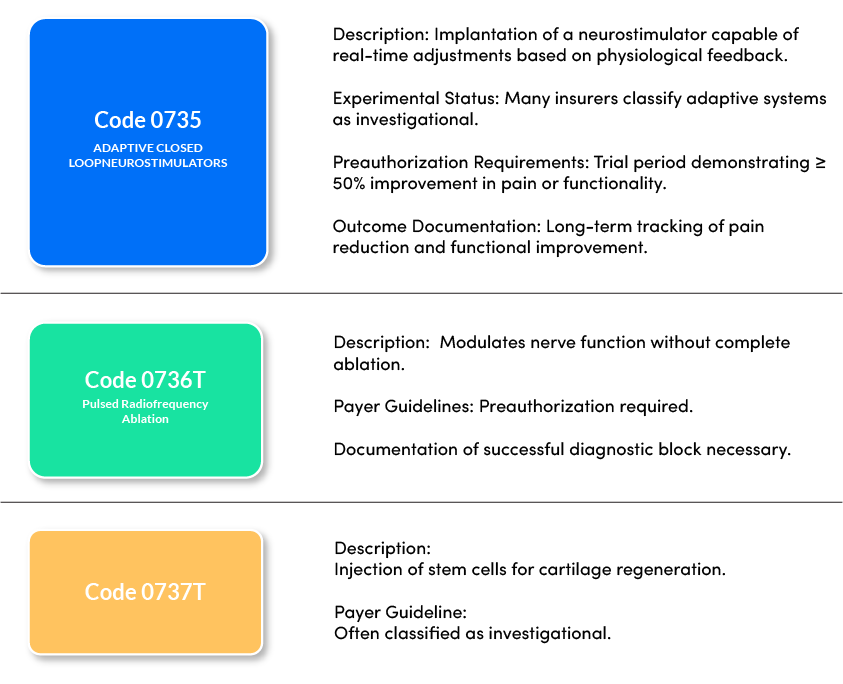
- The adoption of minimally invasive techniques like spinal cord stimulators and radiofrequency ablation.
- Integration of imaging guidance into standard procedural codes.
- Expansion into regenerative medicine, reflecting the shift toward biologics and personalized treatments.
- Neolytix • Contact Us
Schedule a Consultation
Neolytix partners with healthcare organizations across revenue cycle, credentialing, and administrative operations ,14+ years of expertise and AI-enabled automation to reduce inefficiencies and drive sustainable growth.
This guide reflects Neolytix’s expertise in healthcare revenue cycle management and is intended for educational purposes only. It does not constitute legal or compliance advice. CPT codes and reimbursement rates are periodically updated by the AMA and CMS. Always verify current codes and rates using the CMS Physician Fee Schedule Lookup Tool and the AMA CPT code database.
Sources & References
- CMS Physician Fee Schedule Look-Up Tool — Centers for Medicare & Medicaid Services
- Federal Register: CY 2026 Medicare Physician Fee Schedule Final Rule — U.S. Federal Register
- CPT Code Overview and Approval Process — American Medical Association
- National Correct Coding Initiative (NCCI) Edits — CMS
- CMS Local Coverage Determination: MRI Services — CMS
- CMS Chronic Pain Management and Treatment (G3002/G3003) Fact Sheet — CMS
- OIG Fraud Prevention & Compliance Resources — Office of Inspector General, HHS
- American College of Radiology (ACR) Coding & Reimbursement Resources — American College of Radiology
- CMS Local Coverage Determinations (LCDs) Database — CMS
- CMS QPP MIPS Quality Measures Library — Quality Payment Program
- CMS Prior Authorization for Outpatient Imaging Services — CMS
- CMS Remote Physiologic Monitoring (RPM) Policy — CMS
- AAPC Certified Professional Coder (CPC) Certification — AAPC
- CMS Medicare Administrative Contractors (MACs) — CMS


