

- Contact Us +1 224 529 4400
- Schedule A Free Consultation
Pain management practices operate at one of the most complex intersections in medical billing. A single patient encounter may generate E/M codes, procedure codes for injections or nerve blocks, imaging guidance codes, and drug monitoring codes — all subject to strict bundling rules, modifier requirements, and prior authorization mandates. One mismatch can trigger a denial, an audit, or a compliance investigation.
This guide is designed to be the only pain management billing reference your team needs. Whether you’re a coder looking up the difference between 64483 and 64484, a practice administrator building a billing checklist, or a physician trying to understand why a claim was denied — you’ll find a direct answer here.
- Neolytix • Medical Billing
Medical Billing
Why Accurate Pain Management Coding Matters in 2026
For pain management clinics, even a single outdated code can lead to denied claims and lost revenue. The increasing complexity of coding requirements and stricter payer guidelines put practices at financial risk if errors are made. Accurate billing is no longer optional, it’s essential.
| Complexity: Navigating evolving CPT and ICD-10 guidelines is time-intensive and error-prone. | Financial Risk: Denials and audits caused by inaccurate billing result in costly repercussions. |
Pain Management CPT Code Cheat Sheet (Quick Reference)
The most frequently billed pain management CPT codes — organized by category for fast lookup. Bookmark this table as your daily reference.
E/M & Office Visits
| CPT Code | Description | 2026 Medicare (approx.) |
|---|---|---|
| 99213 | Established patient, low-moderate complexity, 20–29 min | ~$78 |
| 99214 | Established patient, moderate complexity, 30–39 min | ~$113 |
| 99215 | Established patient, high complexity, 40–54 min | ~$154 |
| 99203 | New patient, low complexity, 30–44 min | ~$116 |
| 99204 | New patient, moderate complexity, 45–59 min | ~$171 |
| 99205 | New patient, high complexity, 60–74 min | ~$225 |
Injections & Joint Procedures
| CPT Code | Description | 2026 Medicare (approx.) |
|---|---|---|
| 20552 | Trigger point injection, 1–2 muscle groups | ~$52 |
| 20553 | Trigger point injection, ≥3 muscle groups | ~$62 |
| 20550 | Injection, single tendon sheath or ligament | ~$48 |
| 20610 | Arthrocentesis/injection, major joint or bursa | ~$54 |
| 20611 | Arthrocentesis/injection, major joint with US guidance | ~$100 |
| 64450 | Injection, anesthetic agent; other peripheral nerve | ~$52 |
| 64405 | Greater occipital nerve block | ~$60 |
| 64415 | Brachial plexus block, single injection | ~$62 |
Epidurals & Facet Injections
| CPT Code | Description | 2026 Medicare (approx.) |
|---|---|---|
| 62321 | Epidural injection, cervical/thoracic, with imaging | ~$213 |
| 62323 | Epidural injection, lumbar/sacral, with imaging | ~$213 |
| 64479 | Transforaminal epidural, cervical/thoracic, single level | ~$215 |
| 64483 | Transforaminal epidural, lumbar/sacral, single level | ~$215 |
| 64490 | Facet joint injection, cervical/thoracic, single level | ~$137 |
| 64493 | Facet joint injection, lumbar/sacral, single level | ~$137 |
| 64520 | Sympathetic nerve block, lumbar/thoracic | ~$163 |
Radiofrequency Ablation & Neurolytic Procedures
| CPT Code | Description | 2026 Medicare (approx.) |
|---|---|---|
| 64625 | RFA, nerve innervating sacroiliac joint | ~$286 |
| 64633 | Destruction, facet nerve, cervical/thoracic, single | ~$263 |
| 64635 | Destruction, facet nerve, lumbar/sacral, single | ~$263 |
| 64640 | Destruction, other peripheral nerve or branch | ~$205 |
Chronic Pain Management & CCM
| CPT/HCPCS Code | Description | 2026 Medicare (approx.) |
|---|---|---|
| G3002 | Chronic pain management, monthly bundle, first 30 min | ~$95 |
| G3003 | Chronic pain management, each additional 15 min | ~$48 |
| 99490 | Chronic care management, ≥20 min clinical staff time/month | ~$63 |
| 99491 | CCM, ≥30 min direct physician time/month | ~$87 |
| 99487 | Complex CCM, ≥60 min, moderate-high complexity | ~$135 |
* Rates are illustrative estimates based on 2026 MPFS conversion factor of $32.35/RVU. Actual reimbursement varies by geographic locality (GPCI adjustments), facility vs. non-facility setting, and payer contract. Verify via CMS PFS Look-Up.
Overview of Pain Management Billing Code Categories
To code accurately, it’s crucial to understand the structure of CPT codes and their three primary categories. Each serves a unique purpose in medical billing:
Category I: Codes
These codes have descriptors that correspond to a procedure or service.
Range: 00100–99499.
Example: 20604 – Arthrocentesis with ultrasound guidance for small joints.
Category II: Tracking Codes
Supplemental tracking codes for performance measurement.
Example: 0521F – Documentation of a pain management care plan.
Category III: Temporary Codes
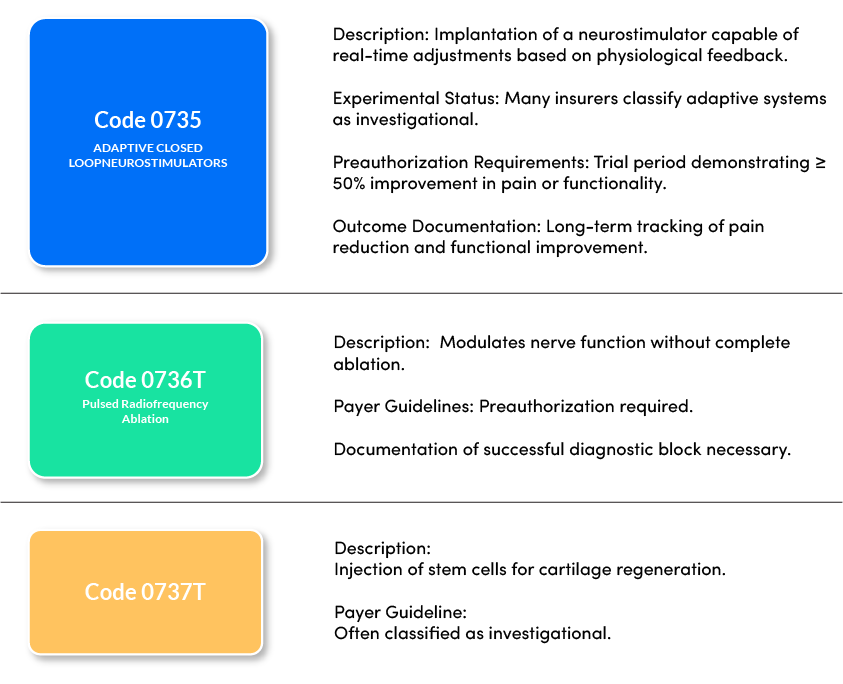
Temporary codes for emerging technologies or procedures.
Example: 0095T – Removal of total disc arthroplasty.
Becoming familiar with them and understanding the category will help with chronic management code selection. It will also assist with coding accuracy and capturing specific codes in addition to the primary code.
- Neolytix • Medical Billing
Medical Billing
What’s New for 2026?
Here is the outline of the changes done for pain management CPT’s-
- The adoption of minimally invasive techniques like spinal cord stimulators and radiofrequency ablation.
- Integration of imaging guidance into standard procedural codes.
- Expansion into regenerative medicine, reflecting the shift toward biologics and personalized treatments.
E/M Office Visit Codes for Pain Management
Evaluation and Management (E/M) codes are the backbone of pain management billing — yet they’re one of the most common sources of under-coding, over-coding, and audit triggers. Since the 2021 AMA E/M guideline overhaul, code selection is based on either Medical Decision Making (MDM) or total time spent on the date of service, not on the number of history and exam elements documented.
Established Patient Codes (99211–99215)
| Code | MDM Complexity | Total Time (same-day) | Common Pain Management Use |
|---|---|---|---|
| 99211 | N/A (nurse visit) | ≤10 min | Prescription refill check, vitals only |
| 99212 | Straightforward | 10–19 min | Stable patient, single chronic issue |
| 99213 | Low | 20–29 min | Established pain patient, medication management |
| 99214 | Moderate | 30–39 min | Multiple chronic pain conditions, treatment adjustment |
| 99215 | High | 40–54 min | Complex patient with uncontrolled pain, comorbidities, or opioid risk |
New Patient Codes (99202–99205)
| Code | MDM Complexity | Total Time | Common Pain Management Use |
|---|---|---|---|
| 99202 | Straightforward | 15–29 min | New patient, single acute pain complaint |
| 99203 | Low | 30–44 min | New patient with one or two chronic pain conditions |
| 99204 | Moderate | 45–59 min | New patient requiring detailed assessment and treatment plan |
| 99205 | High | 60–74 min | Complex new patient, multiple pain diagnoses, opioid evaluation |
Prolonged Services Add-On
99417 (Prolonged services, each additional 15 minutes) can be reported alongside 99205 or 99215 when total time exceeds the maximum threshold for those codes. For 99205, report 99417 for each 15-minute increment beyond 74 minutes. For 99215, each 15-minute increment beyond 54 minutes.
Injection CPT Codes
Injections represent the most frequently billed procedures in pain management. Selecting the correct code depends on the injection site, number of injection sites, whether imaging guidance was used, and whether the injection was therapeutic or diagnostic.
Trigger Point Injections
Trigger points are hyperirritable spots in skeletal muscle that cause local and referred pain. Injections of anesthetic, corticosteroid, or saline into these sites are among the most common pain management procedures.
| Code | Description | Key Documentation Requirement |
|---|---|---|
| 20552 | Injection, single or multiple trigger points; 1 or 2 muscle groups | Identify specific muscle(s) and number of injections; document palpable trigger point |
| 20553 | Injection, single or multiple trigger points; 3 or more muscle groups | Document each muscle group treated; note patient response |
Tendon Sheath, Ligament & Ganglion Cyst Injections
| Code | Description |
|---|---|
| 20550 | Injection, single tendon sheath, or ligament, aponeurosis |
| 20551 | Injection, single tendon origin/insertion |
| 20612 | Aspiration and/or injection of ganglion cyst(s), any location |
Joint Injections & Arthrocentesis
Joint aspiration and injection codes are determined by joint size (small, intermediate, or major) and whether ultrasound guidance was used.
| Code | Description | Common Diagnoses |
|---|---|---|
| 20600 | Arthrocentesis, aspiration/injection; small joint (finger, toe) | M19.0x, M70.xx |
| 20604 | Arthrocentesis, small joint with ultrasound guidance | M19.0x with complex anatomy |
| 20605 | Arthrocentesis, aspiration/injection; intermediate joint (wrist, elbow, ankle) | M19.1x, M70.3x |
| 20606 | Arthrocentesis, intermediate joint with ultrasound guidance | M19.1x, difficult anatomy |
| 20610 | Arthrocentesis, aspiration/injection; major joint (knee, shoulder, hip) | M19.90, M17.xx, M75.xx |
| 20611 | Arthrocentesis, major joint with ultrasound guidance | Obese patients, difficult anatomy |
Sacroiliac Joint Injections
| Code | Description | Notes |
|---|---|---|
| 27096 | Injection procedure for sacroiliac joint, with imaging guidance | Requires fluoroscopy or CT guidance; document diagnostic vs. therapeutic intent |
Epidural Injection Codes
Epidural steroid injections (ESIs) are one of the most common interventional pain procedures. There are two main approaches — interlaminar (the needle enters the epidural space between laminae) and transforaminal (the needle enters through the neuroforamen, targeting a specific nerve root). Coding differs for each approach, spinal level, and whether imaging guidance was used.
Interlaminar Epidural Injections
| Code | Description | Imaging Required? |
|---|---|---|
| 62320 | Interlaminar epidural injection, cervical or thoracic; without imaging | No |
| 62321 | Interlaminar epidural injection, cervical or thoracic; with imaging guidance | Yes — bundled |
| 62322 | Interlaminar epidural injection, lumbar or sacral; without imaging | No |
| 62323 | Interlaminar epidural injection, lumbar or sacral; with imaging guidance | Yes — bundled |
Transforaminal Epidural Injections
| Code | Description | Add-On (each additional level) |
|---|---|---|
| 64479 | Transforaminal epidural, anesthetic/steroid; cervical/thoracic, single level | +64480 (each additional level) |
| 64480 | +Add-on: each additional cervical/thoracic level | Listed with 64479 |
| 64483 | Transforaminal epidural, anesthetic/steroid; lumbar/sacral, single level | +64484 (each additional level) |
| 64484 | +Add-on: each additional lumbar/sacral level | Listed with 64483 |
Facet Joint Injection & Medial Branch Block Codes
Facet joint injections and medial branch blocks (MBBs) are used both diagnostically (to confirm facet-mediated pain) and therapeutically. Accurate coding requires specifying the spinal level (cervical/thoracic vs. lumbar/sacral) and whether the injection is into the joint itself or blocking the medial branch nerve that supplies it.
| Code | Description | Add-On Code | Annual Limit (Medicare) |
|---|---|---|---|
| 64490 | Facet joint/medial branch block, cervical or thoracic; single level | +64491 (2nd level), +64492 (3rd+) | 3 injections per site |
| 64491 | +Add-on: cervical/thoracic, second level | Listed with 64490 | — |
| 64492 | +Add-on: cervical/thoracic, third & subsequent levels | Listed with 64490 | — |
| 64493 | Facet joint/medial branch block, lumbar or sacral; single level | +64494 (2nd level), +64495 (3rd+) | 3 injections per site |
| 64494 | +Add-on: lumbar/sacral, second level | Listed with 64493 | — |
| 64495 | +Add-on: lumbar/sacral, third & subsequent levels | Listed with 64493 | — |
Diagnostic Efficacy Documentation
For therapeutic facet injections, most Medicare Administrative Contractors (MACs) require documentation that a previous diagnostic injection produced ≥50% temporary pain relief for a specified duration (commonly 2–4 hours for diagnostic MBB, 50% relief from facet injection). Without this documentation, therapeutic injections are subject to denial. Maintain a pain diary or numeric rating scale (NRS) record in the chart.
Radiofrequency Ablation (RFA) CPT Codes
Radiofrequency ablation (RFA) uses heat generated by radiofrequency energy to disrupt the medial branch nerves that transmit facet joint pain, providing longer-lasting relief than injections. RFA is also used for sacroiliac joint pain and certain peripheral nerve conditions. It is one of the highest-reimbursed pain management procedures — and one of the most frequently audited.
| Code | Description | Add-On Code | Notes |
|---|---|---|---|
| 64625 | RFA, nerve innervating sacroiliac joint, with imaging guidance; first nerve(s) | +64626 (each additional nerve) | Newer code; verify MAC coverage |
| 64633 | Destruction, neurolytic agent; paravertebral facet joint nerve, cervical/thoracic; single facet joint | +64634 (each additional) | Imaging guidance now bundled |
| 64634 | +Add-on: each additional cervical/thoracic facet level | Listed with 64633 | — |
| 64635 | Destruction, neurolytic agent; paravertebral facet joint nerve, lumbar/sacral; single facet joint | +64636 (each additional) | Imaging guidance now bundled |
| 64636 | +Add-on: each additional lumbar/sacral facet level | Listed with 64635 | — |
| 64640 | Destruction, neurolytic agent; other peripheral nerve or branch | None | For celiac plexus, superior hypogastric plexus, etc. |
RFA Prior Authorization & Documentation Requirements
Medicare and most commercial payers require that a patient undergo two positive diagnostic medial branch blocks (MBBs) with at least 50–80% pain relief before approving RFA. The timeframe between the two diagnostic blocks and between the last block and the RFA procedure varies by payer and MAC policy. Key documentation elements include:
- Two documented positive MBBs (dates, percentage of relief, duration)
- Numeric pain scale recorded before and after each diagnostic block
- Confirmed failure of conservative treatment (physical therapy, medications)
- MRI or CT confirming facet degeneration or spondylosis (for some MACs)
- Procedure note including electrode placement, temperature, and impedance readings
Spinal Cord Stimulator (SCS) CPT Codes
Spinal cord stimulation involves implanting electrodes in the epidural space to modulate pain signals. The billing process is two-stage: a trial period followed by permanent implantation if the trial is successful (typically defined as ≥50% pain reduction). Each stage has separate CPT codes.
Trial Phase
| Code | Description |
|---|---|
| 63650 | Percutaneous implantation of neurostimulator electrode array, epidural |
| 63663 | Revision/replacement of spinal neurostimulator electrode percutaneous array(s) |
| 95970 | Electronic analysis of implanted neuro device, without reprogramming |
| 95971 | Electronic analysis, simple or complex neurostimulator device, with simple reprogramming |
Permanent Implant Phase
| Code | Description |
|---|---|
| 63655 | Laminectomy for implantation of neurostimulator electrodes, plate/paddle electrode |
| 63685 | Insertion of spinal neurostimulator pulse generator or receiver, direct or inductive coupling |
| 63688 | Revision or replacement of spinal neurostimulator pulse generator or receiver |
Ultrasound & Fluoroscopy Guidance Codes
Many injection and ablation procedures require real-time imaging guidance to ensure accurate needle placement. Since 2024, imaging guidance has been bundled into an increasing number of pain management procedure codes. Understanding which codes still allow separate imaging billing — and which do not — is critical for avoiding claim denials.
| Code | Description | Separately Billable With… |
|---|---|---|
| 76942 | Ultrasonic guidance for needle placement, imaging supervision & interpretation | 20605 (intermediate joint), 20600 (small joint), some peripheral nerve blocks |
| 77002 | Fluoroscopic guidance for needle placement | 27096 (SI joint); do NOT bill with 62321-62327 or 64490-64495 (bundled) |
| 77003 | Fluoroscopic guidance for spinal procedures | Check current bundling edits — many procedures now bundle this |
| 77012 | CT guidance for needle placement | Certain abscess drains, deep injections; verify per procedure |
Fascial Plane & Abdominal Block Codes (Newer CPT Codes)
These relatively new codes cover fascial plane blocks for thoracic, lower extremity, and abdominal pain — procedures increasingly used for post-operative pain management and chronic regional pain. They include imaging guidance within the code descriptor when performed.
Thoracic & Lower Extremity Fascial Plane Blocks
| Code | Description |
|---|---|
| 64466 | Unilateral thoracic fascial plane block by injection(s), with imaging guidance when performed |
| 64467 | Unilateral thoracic fascial plane block by continuous infusion(s), with imaging guidance when performed |
| 64468 | Bilateral thoracic fascial plane block by injection(s), with imaging guidance when performed |
| 64469 | Bilateral thoracic fascial plane block by infusion(s), with imaging guidance when performed |
| 64473 | Unilateral lower extremity fascial plane block by injection(s), with imaging guidance when performed |
| 64474 | Unilateral lower extremity fascial plane block by infusion(s), with imaging guidance when performed |
Abdominal Plane Block Codes
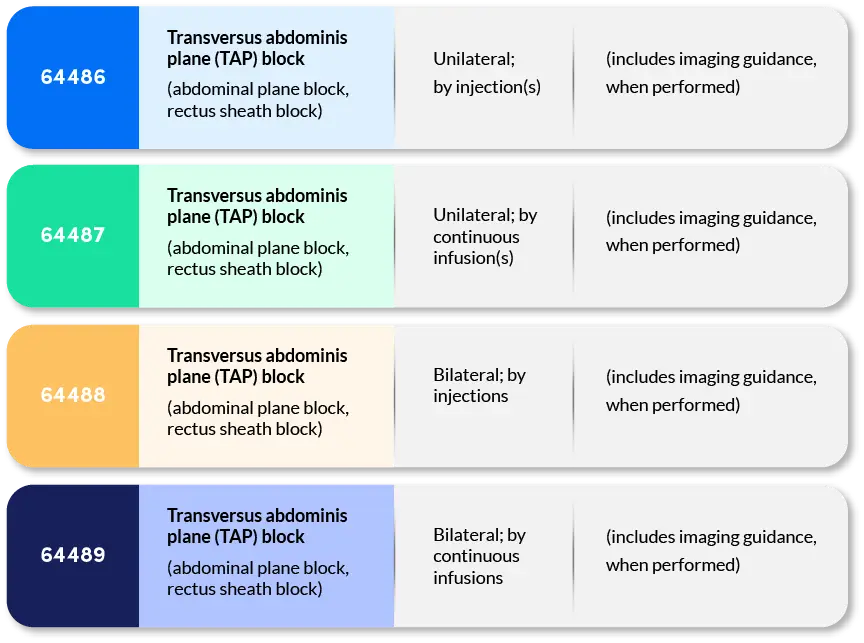
Transversus abdominis plane (TAP) blocks and rectus sheath blocks are used for abdominal wall pain and post-operative analgesia following abdominal surgery. These codes bundle imaging guidance when performed.
| Code | Description |
|---|---|
| 64486 | Transversus abdominis plane (TAP) block, unilateral; by injection(s) |
| 64487 | TAP block, unilateral; by continuous infusion(s) |
| 64488 | TAP block, bilateral; by injection(s) |
| 64489 | TAP block, bilateral; by continuous infusion(s) |
ICD-10 Codes for Pain Management
The ICD-10 code on a claim must accurately describe the patient’s diagnosis and, critically, must support the medical necessity of the billed procedure. Using an overly vague pain code (like R52 — “Pain, unspecified”) where a more specific code exists is a common cause of denials and down-coding.
Chronic Pain Codes (G89 Category)
| ICD-10 Code | Description | Notes |
|---|---|---|
| G89.0 | Central pain syndrome | Use for thalamic pain, phantom limb pain |
| G89.11 | Acute pain due to trauma | Acute onset; use M codes for specific injury site |
| G89.12 | Acute post-thoracotomy pain | — |
| G89.18 | Other acute post-procedural pain | — |
| G89.21 | Chronic pain due to trauma | Document traumatic origin |
| G89.22 | Chronic post-thoracotomy pain | — |
| G89.28 | Other chronic post-procedural pain | Post-surgical pain beyond expected recovery |
| G89.29 | Other chronic pain | Use when no more specific code applies |
| G89.3 | Neoplasm-related pain | For cancer pain — use alongside neoplasm code |
| G89.4 | Chronic pain syndrome | Requires psychological component; document carefully |
Musculoskeletal Pain Codes (M54 Category)
| ICD-10 Code | Description |
|---|---|
| M54.2 | Cervicalgia |
| M54.3 | Sciatica |
| M54.4 | Lumbago with sciatica |
| M54.50 | Low back pain, unspecified |
| M54.51 | Vertebrogenic low back pain |
| M54.59 | Other low back pain |
| M54.81 | Occipital neuralgia |
| M54.89 | Other spinal pain (thoracic, sacral) |
| M79.7 | Fibromyalgia |
| M19.90 | Unspecified osteoarthritis, unspecified site |
Other Frequently Used Pain Management Diagnoses
| ICD-10 Code | Description |
|---|---|
| M47.816 | Spondylosis with radiculopathy, lumbar region |
| M48.06 | Spinal stenosis, lumbar region |
| M53.3 | Sacrococcygeal disorders, NEC |
| G57.10 | Meralgia paresthetica, unspecified lower limb |
| M96.1 | Post-laminectomy syndrome, NEC |
| G90.50 | Complex regional pain syndrome I, unspecified |
| R52 | Pain, unspecified — Use only when no more specific code is available |
Modifiers in Pain Management Billing
Modifiers are two-digit codes appended to CPT codes that provide additional information about a service. In pain management, incorrect modifier use is one of the leading causes of claim denials. The following modifiers are used most frequently.
| Modifier | Meaning | Pain Management Application |
|---|---|---|
| 25 | Significant, separately identifiable E/M service on the same day as a procedure | Append to the E/M code (e.g., 99214-25) when an office visit and a procedure (e.g., trigger point injection) are performed on the same day. Documentation must support a separate E/M decision. |
| 50 | Bilateral procedure | Append to procedure code when the identical procedure is performed on both sides (e.g., bilateral knee injection, bilateral facet blocks). Some payers want two lines with LT and RT instead of Modifier 50. Verify by payer. |
| LT / RT | Left side / Right side | Use instead of or in conjunction with Modifier 50 for bilateral procedures per payer instructions. Commonly required by Medicare Advantage and commercial plans for laterality-specific procedures. |
| 59 | Distinct procedural service | Used to bypass NCCI bundling edits when two procedures are genuinely separate and distinct. Must be supported by documentation. Overuse of 59 is an OIG audit trigger. |
| XU | Unusual non-overlapping service (subset of 59) | Preferred alternative to Modifier 59 in many circumstances. Use when services are distinct because they do not overlap technically or anatomically. |
| 76 | Repeat procedure by same physician | When the same procedure is repeated on the same day (e.g., failed first injection attempt requiring a second attempt with repositioning). |
| 52 | Reduced services | When a procedure is partially reduced at physician’s discretion. Less common in pain management. |
| TC / 26 | Technical Component / Professional Component | When imaging interpretation (e.g., fluoroscopy supervision) is split between the facility and the physician reading. Use when billing in a hospital outpatient setting. |
“Modifiers 59 and XU are among the most scrutinized codes in pain management. Every use should be supported by a chart note explaining why the services were distinct — not just a modifier appended to a claim.”— Neolytix Coding Compliance Team
Drug Testing & Toxicology Codes in Pain Management
Urine drug testing (UDT) is a fundamental part of opioid prescribing compliance and is billable when clinically appropriate. Pain management practices must navigate two distinct testing tiers — presumptive (immunoassay screening) and definitive (chromatography confirmation) — with markedly different codes and reimbursement rates.
Presumptive Drug Testing (Screening)
Presumptive testing provides a qualitative yes/no result for drug classes (e.g., opiates, benzodiazepines, amphetamines). Results are reviewed and interpreted by the ordering clinician.
| Code | Description | Notes |
|---|---|---|
| 80305 | Drug test(s), presumptive; any number of drug classes, any number of devices or procedures, capable of being read by direct optical observation only | Point-of-care cup test; physician reads result in office |
| 80306 | Drug test(s), presumptive; any number of drug classes, any number of devices or procedures, read by instrument-assisted direct optical observation | Point-of-care with instrument reader |
| 80307 | Drug test(s), presumptive; any number of drug classes, any number of devices or procedures, by instrument chemistry analyzers | Lab-based immunoassay; billed by performing lab |
Definitive Drug Testing (Confirmation)
Definitive testing uses gas chromatography-mass spectrometry (GC-MS) or liquid chromatography-tandem mass spectrometry (LC-MS/MS) to identify specific substances and quantify them. Codes are based on the number of drug classes tested.
| Code | Description |
|---|---|
| G0480 | Drug test(s), definitive, utilizing drug identification methods able to identify individual drugs and distinguish from other substances; 1–7 drug class(es) |
| G0481 | Definitive drug testing, 8–14 drug class(es) |
| G0482 | Definitive drug testing, 15–21 drug class(es) |
| G0483 | Definitive drug testing, 22 or more drug class(es) |
Physician Review Code
| Code | Description |
|---|---|
| G2023 | Specimen validity testing, any number of drugs; billed by ordering physician when reviewing results with clinical decision-making |
Chronic Pain Management Codes: G3002 & G3003
Effective January 1, 2023, CMS introduced two new HCPCS codes specifically for chronic pain management (CPM) services. These codes are distinct from Chronic Care Management (CCM) codes and represent a dedicated monthly payment bundle for pain-specific care coordination. They are among the most underutilized revenue opportunities in pain management practices.
G3002 — First 30 Minutes
Monthly bundle covering: diagnosis and assessment; validated pain rating scale administration; person-centered care plan development; medication management; pain and health literacy counseling; behavioral health coordination; crisis care; and care coordination with physical therapy, occupational therapy, and community resources.
Requirement: Initial face-to-face visit of ≥30 minutes by a physician or other qualified health professional (QHP).
2026 Medicare rate: ~$95/month
G3003 — Each Additional 15 Minutes
Add-on code for each additional 15 minutes of chronic pain management and treatment beyond the initial 30 minutes covered by G3002, per calendar month.
Requirement: Listed separately in addition to G3002. 15 minutes must be met or exceeded to bill each unit.
2026 Medicare rate: ~$48/15 min
Who Can Bill G3002 / G3003?
G3002 and G3003 can be billed by physicians, nurse practitioners, physician assistants, or other eligible qualified healthcare professionals — both within pain management specialty and in primary care settings managing long-term pain. Importantly, specialty providers outside of traditional pain management (e.g., orthopedics, rheumatology) who are managing chronic pain patients may also report these codes.
G3002 / G3003 vs. CCM: Key Differences
| Feature | G3002/G3003 (CPM) | 99490/99491 (CCM) |
|---|---|---|
| Focus | Chronic pain management specifically | Any two or more chronic conditions |
| Provider type | Physician or QHP (direct) | Clinical staff under supervision OR direct physician |
| Initial visit required | Yes — face-to-face ≥30 min | Yes — comprehensive E/M, AWV, or IPPE |
| Can bill both in same month? | No — time cannot be double-counted. Bill the most appropriate code for the care provided. | |
| Behavioral health coordination | Explicitly included in descriptor | General chronic condition management |
Chronic Care Management (CCM) Codes
Chronic Care Management (CCM) provides non-face-to-face care coordination for Medicare patients with two or more chronic conditions expected to last at least 12 months or until the patient’s death. Pain management practices with a chronic patient panel are often eligible to bill CCM for patients who don’t meet the more specific CPM criteria.
| Code | Description | Time Requirement | 2026 Medicare (approx.) |
|---|---|---|---|
| 99490 | CCM, clinical staff time, physician directed | ≥20 min/month (clinical staff) | ~$63/month |
| 99491 | CCM, direct physician/QHP time | ≥30 min/month (physician) | ~$87/month |
| G2058 | Add-on: additional 20 min CCM, clinical staff time | +20 min with 99490 | ~$47 |
| G0506 | Comprehensive assessment at CCM initiation | Bill once per initiating visit | ~$63 (once) |
Complex Care Management
Complex Care Management (also abbreviated CCM, confusingly) requires moderate-to-high complexity medical decision-making and a minimum of 60 minutes of care provision monthly.
| Code | Description | Time Requirement |
|---|---|---|
| 99487 | Complex CCM, clinical staff directed | ≥60 min/month, moderate-to-high MDM |
| 99489 | +Add-on: each additional 30 min complex CCM | +30 min; listed with 99487 |
Complex care management shares common required service elements with CCM but also have different requirements. In addition to the CCM required elements, at least 60 minutes of care must be provided. Another difference is the requirement of moderate to high decision making.
There are common conditions that are typically billed with CCM codes. The chronic conditions include but are not limited to:
- Alzheimer’s disease and related dementia
- Arthritis (osteoarthritis and rheumatoid)
- Asthma
- Atrial fibrillation
- Autism spectrum disorders
- Cancer
- Cardiovascular disease
- Chronic Obstructive Pulmonary Disease (COPD)
- Depression
- Diabetes
- Hypertension
- Infectious diseases like HIV and AIDS
2026 MPFS Updates: What Changed for Pain Management
The 2026 Medicare Physician Fee Schedule, finalized in the Federal Register in November 2025, includes several changes that directly affect pain management billing. Understanding these updates is critical for ensuring your fee schedule is accurate and your claims reflect current rates.
2026 Conversion Factor
Key 2026 Changes Affecting Pain Management
| Change | Impact |
|---|---|
| Imaging Guidance Bundling Expanded | Fluoroscopy (77003) is now bundled into facet joint codes (64490–64495) and most interlaminar epidural codes. Do not separately bill 77003 with these procedures effective January 1, 2026. |
| Revised Descriptors for 64490 & 64493 | Anatomical descriptions clarified; imaging guidance explicitly stated as included. Payer pre-authorization language updated to reflect bundled nature. |
| Minimally Invasive Sacroiliac Fusion (New Codes) | New procedure codes added for arthrodesis of the sacroiliac joint using minimally invasive techniques, with specific guidance on implantation approaches. |
| SCS Programming Updates | Revised reimbursement for spinal cord stimulator programming codes (95971–95972) reflecting increased complexity of high-frequency and burst waveform programming. |
| G3002/G3003 Rates Adjusted | Minor rate adjustments to chronic pain management codes reflecting RVU revaluation. Confirm current rates in the CMS PFS Look-Up tool for your locality. |
| Telehealth — Permanent Extension of Certain Services | Several pain management-adjacent telehealth services (including behavioral health integration and certain E/M codes) have been made permanent following PHE-era extensions. See Telehealth section below. |
Prior Authorization in Pain Management
Pain management procedures have some of the highest prior authorization (PA) denial rates of any specialty. According to MGMA data, up to 40% of PA requests in pain management require at least one peer-to-peer review. Building a systematic PA workflow is essential to maintaining practice revenue and reducing administrative burden.
Procedures Requiring Prior Authorization (Most Payers)
| Procedure | Typical Documentation Required |
|---|---|
| Epidural steroid injections (after 2nd injection) | Prior ESI date and response, imaging report (MRI/CT), failed conservative care documentation |
| Radiofrequency Ablation | Two positive diagnostic MBBs with documented ≥50% relief, imaging, conservative care failure |
| Spinal Cord Stimulator Trial | Psych clearance, failed surgery documentation, ≥6 months conservative care, FDA-approved indication |
| Spinal Cord Stimulator Permanent | Successful SCS trial results (≥50% pain reduction), updated functional assessment |
| Sacroiliac joint injection (>2/year) | Positive Fortin finger test, positive Patrick/FABER test, prior injection response |
| Vertebroplasty / Kyphoplasty | MRI confirming acute fracture, DEXA scan, fracture age, conservative trial |
PA Best Practices for Pain Management Practices
- Designate a dedicated PA coordinator who tracks submissions, follow-up timelines, and appeal deadlines
- Build payer-specific PA checklists for your top 5–8 procedures and update them quarterly
- Document the “medical necessity narrative” in the patient chart before submitting the PA — this is your best defense against denials
- When denied, request the clinical criteria used for denial (required under most state laws and the No Surprises Act) and respond with peer-reviewed literature supporting the procedure
- Use peer-to-peer calls proactively for high-cost procedures rather than waiting for denial
Telehealth & Remote Patient Monitoring in Pain Management
Telehealth permanently expanded the scope of billable pain management services following the COVID-19 Public Health Emergency (PHE). As of 2026, several telehealth services that were temporarily authorized during the PHE have been made permanent by CMS.
Permanently Available Pain Management Telehealth Services (2026)
| Service | CPT/HCPCS Code(s) | Notes |
|---|---|---|
| E/M visits (established patient) | 99212–99215 | Audio-video; patient may be in any setting |
| E/M visits (new patient) | 99202–99205 | Some MACs maintain geographic restrictions for new patients; verify locally |
| Behavioral health integration (telehealth) | 99484, 99492–99494 | Permanently extended |
| CPM services (G3002, G3003) | G3002, G3003 | Non-face-to-face component may be delivered via telehealth after initiating visit |
Remote Patient Monitoring (RPM) in Pain Management
RPM allows practices to monitor patients’ pain levels, medication adherence, and activity data between visits using wearables or patient-reported apps. For chronic pain patients, RPM can improve outcomes and generate meaningful ancillary revenue.
| Code | Description | 2026 Medicare (approx.) |
|---|---|---|
| 99453 | Remote monitoring setup and patient education (one-time) | ~$20 |
| 99454 | Device supply and daily transmission, each 30 days | ~$55/month |
| 99457 | RPM treatment management, first 20 minutes/month, interactive communication | ~$52/month |
| 99458 | +Add-on: each additional 20 minutes/month | ~$42/month |
MIPS Quality Reporting for Pain Management Practices
The Merit-based Incentive Payment System (MIPS) affects Medicare physician payment adjustments based on performance in four categories: Quality, Cost, Improvement Activities, and Promoting Interoperability. Pain management physicians participating in Medicare must understand their MIPS reporting obligations to avoid negative payment adjustments (up to -9% in 2026).
Relevant MIPS Quality Measures for Pain Management
| Measure # | Description | Relevance |
|---|---|---|
| 131 | Pain Assessment and Follow-Up | Core measure for pain practices — documents pain using a validated tool and follow-up plan |
| 226 | Preventive Care and Screening: Tobacco Use | Important for patients on opioid therapy; tobacco use affects pain outcomes |
| 316 | Preventive Care and Screening: Screening for Depression and Follow-Up Plan | Critical for chronic pain patients — comorbid depression affects treatment outcomes and opioid risk |
| 024 | Communication with the Physician or Other Clinician Managing Ongoing Care Post-Fracture | For practices treating osteoporotic fracture pain |
| 128 | Preventive Care: Body Mass Index (BMI) Screening and Follow-Up | Obesity is a major complicating factor in spinal pain management |
Reference: CMS QPP Quality Measures Library for the complete and current list of eligible measures.
Audit Readiness & Compliance Red Flags
Pain management is consistently among the top five specialties targeted by CMS Recovery Audit Contractors (RAC), Zone Program Integrity Contractors (ZPIC), and the OIG. Understanding what triggers audits — and maintaining documentation that withstands scrutiny — is an operational imperative, not just a billing best practice.
High Frequency of High-Level E/M
Consistently billing 99215 for the majority of encounters without documented complexity. Coders should periodically audit E/M level distribution and compare against specialty benchmarks.
RFA Without Documented Diagnostic Blocks
Billing 64633/64635 without two prior positive MBB records in the chart. RAC auditors specifically look for this gap. Maintain a procedure prerequisites checklist.
Unbundled Imaging Guidance
Billing 77003 or 76942 alongside procedure codes that already include imaging in their descriptor (e.g., 64490-64495, 62321-62323). Check NCCI edits quarterly.
Routine Definitive Drug Testing
Ordering G0480–G0483 at every visit without individualized clinical justification. Each order must have a chart note explaining why confirmatory testing was clinically necessary.
Modifier 25 Overuse
Appending Modifier 25 to every E/M on a procedure day without separate documentation supporting a distinct, significant E/M service. The OIG has flagged this pattern in pain management audits.
SCS Without Prior Authorization Records
Absence of documented PA approval, psych clearance, or failed conservative care in the SCS surgical chart. All pre-procedure requirements must be in the chart before the procedure date.
Common Denial Reasons in Pain Management & How to Prevent Them
Pain management practices experience some of the highest claim denial rates in medicine, often exceeding 15–20% initial denial rates. The following are the most frequently occurring denial types with specific prevention strategies.
| Denial Reason Code | What It Means | Prevention Strategy |
|---|---|---|
| CO-4 | Service inconsistent with the patient’s age | Double-check ICD-10 codes against patient demographics. Some pain codes have age-specific restrictions. |
| CO-11 | Diagnosis inconsistent with procedure | Map every CPT code to a supporting ICD-10 code in the chart. G89.29 alone may not justify a SCS implant — use the underlying anatomical diagnosis (e.g., M96.1 for failed back syndrome). |
| CO-97 | Payment included in allowance for another service (bundling) | Check NCCI edits quarterly. The most common trigger: billing 77003 (fluoroscopy) separately when it’s already bundled into the primary procedure. Run NCCI checks before claim submission. |
| CO-50 / CO-167 | Non-covered service / not medically necessary per payer LCD | Review the applicable Local Coverage Determination (LCD) for every high-cost procedure before performing it. Attach supporting clinical documentation when required by the payer. |
| PR-204 | Service/equipment/drug not covered by this plan | Verify insurance benefits and coverage for specific procedures at the time of scheduling, not just at check-in. |
| CO-151 | Payment adjusted because the payer deems the information submitted does not support this many/frequency of services | Maintain a frequency tracking log. For epidurals, facet injections, and trigger point injections, flag when a patient approaches payer-specific frequency limits. |
| CO-B7 | This provider was not certified/eligible to be paid for this procedure on this date of service | Credential issues — verify that the treating provider is enrolled with the payer and the correct NPI is on the claim. Especially common for newly hired mid-levels performing procedures under supervision. |
Incident-to Billing: The Most Dangerous Compliance Risk
Incident-to billing allows advanced practice providers (APPs — NPs, PAs) to bill under the supervising physician’s NPI at 100% of the physician fee schedule (vs. 85% under their own NPI). However, the requirements are strict and frequently misapplied in pain management:
- The supervising physician must be physically present in the office suite (not just the building) during the service
- The billing physician must have established the patient’s plan of care in a prior visit
- The visit must be for a stable, established condition — any new problem or significant change must be seen by the physician
- Incident-to billing is not allowed for hospital outpatient or inpatient settings, only in the office
Complex Care Management
Complex care management shares common required service elements with CCM but also have different requirements. In addition to the CCM required elements, at least 60 minutes of care must be provided. Another difference is the requirement of moderate to high decision making.
There are common conditions that are typically billed with CCM codes. The chronic conditions include but are not limited to:
- Alzheimer’s disease and related dementia
- Arthritis (osteoarthritis and rheumatoid)
- Asthma
- Atrial fibrillation
- Autism spectrum disorders
- Cancer
- Cardiovascular disease
- Chronic Obstructive Pulmonary Disease (COPD)
- Depression
- Diabetes
- Hypertension
- Infectious diseases like HIV and AIDS
Understanding Pain Management
Mastering essential CPT and ICD-10 codes is key to accurate pain management billing. Codes like G89.29 (chronic pain), M54.5 (low back pain), and G89.4 (chronic pain syndrome) ensure precise documentation, while 99490 covers chronic care management services.
Staying compliant means following up-to-date billing guidelines and leveraging tools like cheat sheets to minimize errors. For chronic back pain, M54.5 is a go-to code, while procedures such as therapeutic injections often use 20526.
Interventional approaches, including 64405 for occipital nerve blocks, are crucial for effective pain management. Similarly, joint and muscle pain treatments commonly rely on 20550 for tendon sheath or ligament injections.
Accurate coding not only ensures compliance but also maximizes reimbursements—keeping your practice efficient and aligned with evolving standards.
Simplified CCM and Evaluation for Maximum Impact
Chronic Care Management (CCM) is essential for effective billing and patient care. Accurately using CPT codes ensures your practice receives proper reimbursement while delivering comprehensive care.
| 99490: Covers at least 20 minutes of clinical staff time directed by a qualified healthcare professional per calendar month. Patients must have two or more chronic conditions expected to last 12+ months or until death, with a significant risk of exacerbation, functional decline, or death. |
| 99491: Reserved for care personally delivered by a physician or other qualified healthcare professional for at least 30 minutes monthly. Includes the same requirements as 99490 but involves direct provider time. |


Pro tip: Pair G2058 with 99490 for an additional 20 minutes of work. Use G0506 for extensive assessments outside the usual scope, billable once per initiating visit

Conclusion
Medical coding and billing for chronic pain management can feel overwhelming, with codes spread across different categories and ever-changing guidelines. But you don’t have to tackle it alone.
At Neolytix, we’re here to simplify the process, ensuring your practice stays accurate, compliant, and profitable. Whether you need help with billing, coding, or revenue cycle management, our expert team has you covered. At Neolytix, we provide:
- End-to-end HIPAA-compliant billing solutions.
- Expertise in chronic care and complex care management codes.
- Tailored support to reduce denials and improve revenue.
Let’s make billing easier. Reach out today, and let’s get started on optimizing your practice!
- Neolytix • Contact Us
Schedule a Consultation
Neolytix partners with healthcare organizations across revenue cycle, credentialing, and administrative operations ,14+ years of expertise and AI-enabled automation to reduce inefficiencies and drive sustainable growth.
This guide reflects Neolytix’s expertise in healthcare revenue cycle management and is intended for educational purposes only. It does not constitute legal or compliance advice. CPT codes and reimbursement rates are periodically updated by the AMA and CMS. Always verify current codes and rates using the CMS Physician Fee Schedule Lookup Tool and the AMA CPT code database.
Frequently Ask Questions
Pain management office visits use standard Evaluation and Management (E/M) codes: 99202–99205 for new patients and 99212–99215 for established patients. Code selection is based on Medical Decision Making (MDM) complexity or total time spent on the date of service, per the 2021 AMA E/M guidelines. Most established patient pain management visits fall under 99213 (low complexity) or 99214 (moderate complexity).
The most frequently used ICD-10 codes for chronic pain are: G89.29 (Other chronic pain), G89.4 (Chronic pain syndrome — requires a psychological component), M54.50 (Low back pain, unspecified), and M54.51 (Vertebrogenic low back pain). Choose the most specific code that reflects the documented diagnosis. Avoid the nonspecific R52 (Pain, unspecified) when a more precise code is available, as it is often insufficient to support medical necessity for interventional procedures.
There are multiple epidural injection codes depending on approach and spinal level. For interlaminar injections: use 62321 (cervical/thoracic with imaging) or 62323 (lumbar/sacral with imaging). For transforaminal injections: use 64479 (cervical/thoracic) or 64483 (lumbar/sacral) for single level. Add-on codes 64480 and 64484 apply for each additional level billed. Imaging guidance is bundled into most of these codes as of 2026 — do not separately bill fluoroscopy.
Both codes describe radiofrequency ablation (destruction of facet joint nerves) but differ by spinal level. 64633 is used for cervical or thoracic facet nerve destruction; 64635 is for lumbar or sacral. Each has a corresponding add-on code for additional levels: +64634 (cervical/thoracic) and +64636 (lumbar/sacral). Imaging guidance is bundled into both codes as of 2026.
CMS introduced two dedicated chronic pain management HCPCS codes effective January 1, 2023. G3002 covers the first 30 minutes of the monthly chronic pain management bundle, including care planning, medication management, and coordination with other providers. G3003 is the add-on for each additional 15 minutes beyond the initial 30 minutes. These codes are distinct from the general Chronic Care Management codes (99490, 99491) and can represent $95–$140+ per patient per month in Medicare reimbursement.
Yes — but the E/M visit must be a significant, separately identifiable service above and beyond the routine pre-procedure assessment. Append Modifier 25 to the E/M code (e.g., 99214-25). Your chart documentation must support a distinct clinical decision (e.g., new complaint, medication change, review of imaging results) that would have been performed regardless of the injection. If the E/M is solely the pre-service evaluation for the injection, it is not separately billable.
Drug testing in pain management uses two tiers. Presumptive (screening) testing uses 80305 (direct optical read), 80306 (instrument-assisted read), or 80307 (lab immunoassay). Definitive (confirmatory) testing uses HCPCS G codes: G0480 (1–7 drug classes), G0481 (8–14 classes), G0482 (15–21 classes), G0483 (22+ classes). Definitive testing must be clinically justified — routine ordering on all patients without clinical rationale is an OIG audit target. Document the specific clinical reason for each definitive test in the chart.
Medicare and most payers limit epidural steroid injections — typically 3 injections per spinal level per year, though this varies by MAC jurisdiction and payer contract. Frequency limitations differ for interlaminar vs. transforaminal approaches and for diagnostic vs. therapeutic injections. Always verify the applicable Local Coverage Determination (LCD) for your MAC region and check individual payer policies before scheduling additional injections. Exceeding frequency limits without documented medical necessity is a common audit finding.
G codes are specific to Medicare. For example:
G2211: Office or other outpatient visit for the evaluation and management of a new or established patient, which requires a medically appropriate history and/or examination and straightforward medical decision-making.
The ICD-10 code for pain management involving opioids may include:
F11.20: Opioid dependence, uncomplicated
The ICD-10 code for pain due to medical devices is T85.84XA (Pain due to internal orthopedic prosthetic devices, implants, and grafts).
The ICD-10 code for unspecified pain discomfort is R52.
Chronic pain is classified under ICD-10 code G89.2 (Chronic pain, not elsewhere classified).
Chronic pain is coded using ICD-10 code G89.29 (Other chronic pain). It is important to use accurate pain management coding practices to ensure proper billing and reimbursement.
For chronic pain management services, the relevant CPT codes are:
99490: Chronic care management services, at least 20 minutes of clinical staff time directed by a physician or other qualified healthcare professional, per calendar month
99491: Chronic care management services, provided personally by a physician or other qualified healthcare professional, at least 30 minutes of physician or other qualified healthcare professional time, per calendar month
Staying updated with chronic care management CPT codes 2023 and pain management CPT codes 2024 ensures that practices are billing accurately and efficiently.
Sources & References
- CMS Physician Fee Schedule Look-Up Tool — Centers for Medicare & Medicaid Services
- Federal Register: CY 2026 Medicare Physician Fee Schedule Final Rule — U.S. Federal Register
- CPT Code Overview and Approval Process — American Medical Association
- National Correct Coding Initiative (NCCI) Edits — CMS
- CMS Chronic Pain Management and Treatment (G3002/G3003) Fact Sheet — CMS
- CMS Chronic Care Management FAQ — CMS
- OIG Fraud Prevention & Compliance Resources — Office of Inspector General, HHS
- OIG Report: Modifier 25 Use in Evaluation and Management Services — OIG
- CMS Local Coverage Determinations (LCDs) Database — CMS
- CMS QPP MIPS Quality Measures Library — Quality Payment Program
- CMS 2026 Medicare Telehealth Services List — CMS
- CMS Remote Physiologic Monitoring (RPM) Policy — CMS
- AAPC Certified Professional Coder (CPC) Certification — AAPC
- CMS Medicare Administrative Contractors (MACs) — CMS