


- Key Takeaways
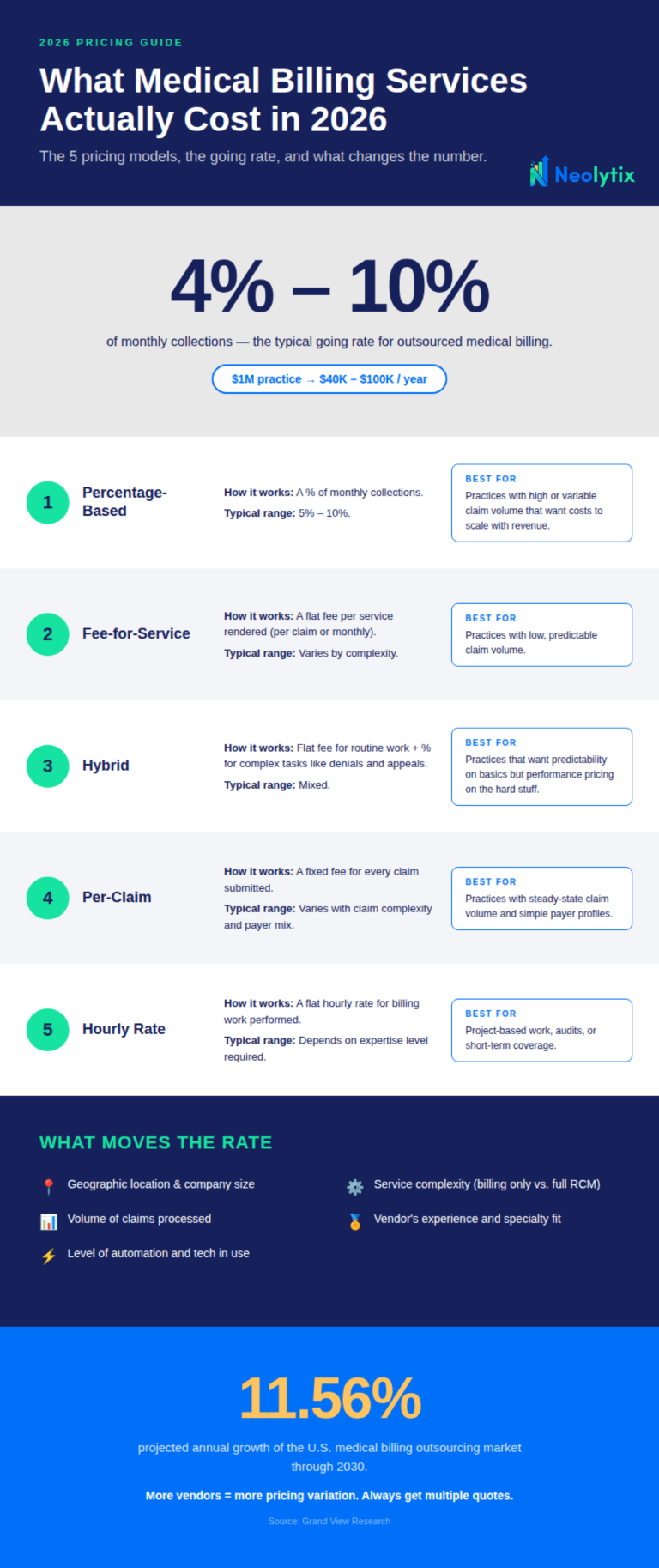
- Medical billing cost in 2026 ranges from 4% to 10% of net collections, with most competitive quotes for small to mid-sized practices falling between 5% and 8%.
- Hidden fees for setup, credentialing, and patient statements can inflate true annual billing costs by 15% to 30% above any quoted percentage rate.
- Medical billing cost is the percentage a vendor charges on collected revenue — always confirm whether the fee applies to gross charges or net collections before comparing quotes.
- Before signing any billing contract, confirm denial management, AR follow-up, and appeals are included in the base fee — not billed separately.
Medical billing cost is one of the most consequential operational decisions a healthcare practice can make, and also one of the least transparent. Most billing companies quote a percentage and leave the rest to fine print.
In 2026, medical billing cost typically ranges from 4% to 10% of monthly collected revenue on a percentage-based model. For a practice collecting $1 million annually, that translates to $40,000 to $100,000 per year in medical billing service fees. But the actual number for any given practice depends on specialty, claim volume, pricing model, payer mix, and what is actually included in the fee.
Medical billing rates in 2026 at a glance
- Percentage of collections: 4% to 10% of net collections, most commonly 5% to 8% for small and mid-sized practices
- Per claim: $3 to $12 per claim, depending on claim complexity and payer type
- Hybrid and hourly pricing: Some vendors combine a base monthly fee with a percentage of collections, or bill hourly for audits and short-term projects. Rates vary widely, so request a written quote.
What Are Medical Billing Rates in 2026?
The benchmark range for outsourced medical billing services cost in 2026 is 4% to 10% of net collections, but that headline figure needs context. Most competitive quotes for small to mid-sized practices fall between 5% and 8%. High-complexity specialties such as cardiology, oncology, and orthopedic surgery typically range from 8% to 12% due to coding complexity, prior authorization volume, and higher denial rates.
You may see narrower ranges quoted, such as 3% to 8% or 4% to 7%. Those usually reflect a specific practice profile, such as a high-volume primary care group, rather than the full market. The rate a practice pays depends on specialty, claim volume and the scope of services included.
Per-claim pricing ranges from $3 to $12 per claim depending on claim complexity and payer type. Flat monthly fees typically run from $500 to $2,500 per month for small to mid-size practices.
One important nuance: what the percentage is applied to matters enormously. Some vendors calculate their fee on gross charges (everything billed before write-offs), while others use net collections (what is actually collected after adjustments). A 5% fee on gross charges will almost always cost significantly more than a 6% fee on net collections. Always confirm the denominator before comparing quotes.
What Factors Affect Medical Billing Service Fees?
When you request quotes from billing companies, you will notice significant variation. Pricing in this industry is not standardized, and the gap between a 4% and 9% fee can represent tens of thousands of dollars annually. The following factors drive where your practice lands in that range.
- Specialty complexity: Billing for primary care is structurally simpler than billing for cardiology, behavioral health, or oncology. High-complexity specialties involve more prior authorizations, detailed modifiers, and higher denial rates, which translates to more work per claim and a higher fee.
- Claim volume: Higher-volume practices often qualify for lower percentage rates because the fixed cost of managing the relationship is distributed across more claims. Solo practitioners typically pay at the higher end of their specialty’s range, while large multi-location groups with ten or more providers often negotiate 4% to 7%
- Scope of services: A basic service covering claim submission and payment posting costs less than a full-service revenue cycle management engagement that includes denial management, appeals, AR recovery, eligibility verification, and performance reporting.
- Technology and automation capabilities: Billing companies investing in AI-assisted coding, claim scrubbing, and real-time denial analytics achieve higher clean-claim rates. This affects both their pricing and the value they deliver.
- Geographic location and company size: Larger billing organizations with national footprints can often price more competitively due to economies of scale. Regional companies may price higher or lower depending on local labor costs and market competition.
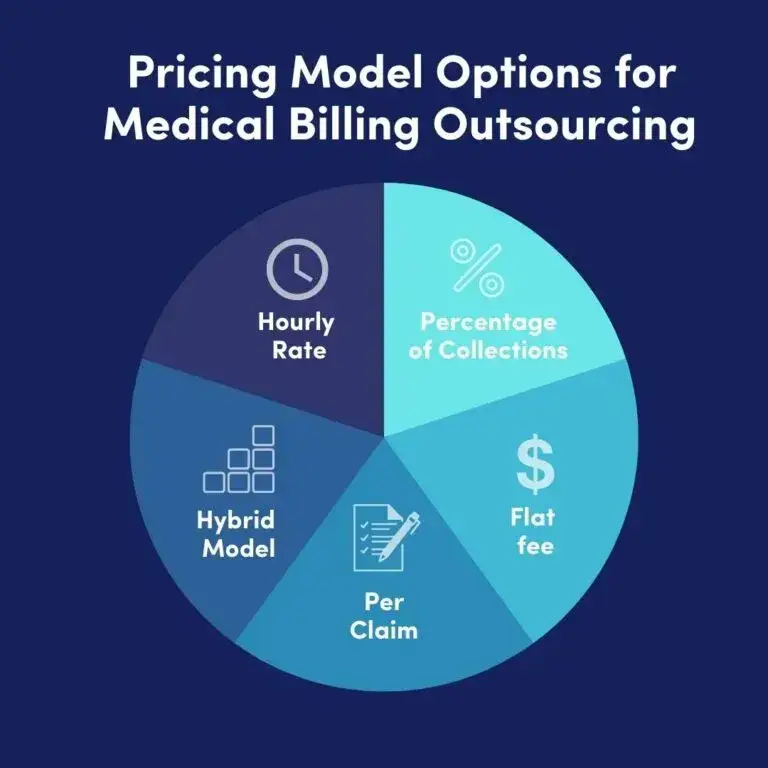
Medical Billing Pricing Models: Percentage, Per Claim, Flat Fee and Hybrid
Every medical billing service uses one of the following pricing structures, or a hybrid of them. Understanding how each model works is essential before comparing quotes or signing a contract.
- Percentage of Collections
The most widely used pricing model. The billing company charges a percentage of the revenue actually collected on your behalf. If collections go up, the billing company earns more. If they underperform, they earn less. This alignment of incentives makes it the preferred model for most practices. For most specialties, the percentage falls between 4% and 10%.
- Per-Claim (Fee-for-Service)
A fixed fee is charged per claim submitted, typically ranging from $3 to $12. This model provides cost predictability but creates a potential misalignment: the billing company is paid the same for a $45 office visit as a $4,000 surgical claim. Confirm how denied or corrected claims are billed under this structure before committing.
How per-claim rates are set: Most vendors price per claim on a sliding scale, with lower rates for simple, high-volume claims and higher rates for claims needing prior authorization, modifiers or manual payer follow-up. Before signing, ask whether the per-claim rate covers resubmissions, secondary claims and patient statements, or whether each is billed as a separate claim.
- Flat Monthly Fee
A fixed monthly charge regardless of revenue or claim volume, typically ranging from $500 to $2,500 per month for small to mid-size practices. This works well for budget predictability but requires close monitoring of billing performance, since the vendor’s income does not scale with your results.
- Hourly Rate
Less common, but available for specific billing tasks, coding audits, or short-term engagements. Hourly rates vary by the skill level required and the scope of work. This model is not practical for ongoing billing operations.
- Hybrid Model
An increasingly popular structure combining a base monthly fee with a percentage of collections, often applied above a defined collection threshold. This balances cost predictability with performance accountability and suits growing practices well. For example, $750 per month plus 3% of collections above a set floor. This balances cost predictability with performance accountability and suits growing practices well.
- Neolytix • Medical Billing
Medical Billing
Medical Billing Pricing Model Comparison
Model | Typical Rate | Best Suited For |
Percentage of collections | 4% to 10% of net collections | High-volume practices; aligns billing company incentives with performance |
Per-claim | $3 to $12 per claim | Lower-volume practices with predictable, uniform claim types |
Flat monthly fee | $500 to $2,500/month | Budget-conscious practices needing cost predictability |
Hourly rate | $20 to $30/hour (Varies by scope) | Ad hoc billing support, coding audits, or project-based work |
Hybrid | Base fee + 3% to 5% of collections (Base fee plus a percentage of collections) | Mid-size and growing practices balancing stability with performance |
Medical Billing Rates by Specialty
Specialty is the single biggest driver of medical billing service fees after claim volume. Higher-complexity specialties involve more prior authorizations, detailed modifier usage, documentation requirements, and higher denial rates, all of which mean more work per claim. For a deeper look at how the full billing process works from encounter to payment, see our guide on what is medical billing.
2026 Medical Billing Cost by Practice Type
Practice Type | Rate Range | Key Cost Driver |
Solo provider, primary care | 5% to 7% | Lower complexity; smaller claim volume |
Small group practice (2 to 5 providers) | 5% to 8% | Volume discounts may apply |
Multi-specialty group | 6% to 9% | Higher complexity; more payer types |
Internal medicine / family practice | 5% to 8% | Established coding patterns; moderate denial rates |
Behavioral health | 6% to 9% | Prior auth volume; payer-specific requirements |
OB-GYN | 6% to 9% | Coding variability; global billing periods |
Cardiology / orthopedic surgery | 8% to 12% | Complex coding; high denial rates; high prior auth volume |
Oncology | 8% to 12% | Intensive documentation; frequent prior auth requirements |
A note on volume and rate: practices with higher per-claim reimbursement such as surgical or cardiology practices are often quoted a higher percentage than primary care. However, a billing company can earn more per claim at a lower percentage on high-volume primary care, so volume shapes the economics of your quote more than specialty alone.
Hidden Costs Beyond the Percentage Billing Fee
The percentage billing fee in a vendor proposal is rarely the complete picture. Additional charges can inflate your true annual cost by 15% to 30% above the quoted rate. Before signing any agreement, confirm how each of the following is handled.
- Setup and onboarding fees: Data migration, EHR integration, and account configuration can cost between $500 and $5,000 as a one-time charge. Some vendors include this; many do not. Others spread it across the first few months of elevated rates.
- Software licensing: If the billing company requires use of their proprietary practice management system, expect an additional $200 to $500 per month. This also creates lock-in that complicates transitions if service quality drops.
- Credentialing fees: Initial payer enrollment is sometimes bundled and sometimes billed separately at $150 to $300 per payer per provider. For a new practice enrolling with ten payers, that is $1,500 to $3,000 per provider before a single claim is filed.
- Patient statement fees: Paper statements to patients may be billed separately at $0.75 to $1.25 per letter, adding $250 to $1,000 per month for a busy practice.
- Denial rework charges: Some vendors charge extra to appeal or rework claims they did not originally submit. Confirm whether denial management and appeals are included in the base rate or billed separately.
- Minimum monthly fees: Some contracts include collection floor requirements or minimum claim volumes. For seasonal practices or those still growing, this can mean paying for capacity that is not being used.
- Annual price escalation clauses: Multi-year contracts may include built-in rate increases. Review the contract for provisions that allow the vendor to raise fees without your approval.
- Termination penalties: Early exit fees and long lock-in periods are among the most significant hidden costs. If a company requires a twelve-month contract with termination penalties, ask why they need a contract to retain clients rather than performance.
Conclusion
Medical billing cost ranges from 4% to 10% of collections in 2026, but the rate alone does not tell you what you are actually getting. A lower percentage that results in a 5% improvement in collection rate through better denial management and cleaner first-pass claims will generate more net revenue than a cheaper service that misses those outcomes.
The right evaluation framework looks at clean-claim rate, AR days, denial resolution speed, and scope of services included, not just the headline percentage. Understanding your full in-house cost, including the revenue you are leaving on the table through write-offs and underpayments, gives you the baseline to make a genuinely informed decision.
With over 14 years of experience supporting healthcare practices of all sizes nationwide, Neolytix delivers end-to-end medical billing and revenue cycle management built around measurable financial outcomes. Whether you are evaluating outsourcing for the first time or reassessing your current billing arrangement, our team can show you exactly where revenue is being left on the table and what a better-structured billing partnership looks like for your practice.
- Neolytix • Contact Us
Schedule a Consultation
Neolytix partners with healthcare organizations across revenue cycle, credentialing, and administrative operations ,14+ years of expertise and AI-enabled automation to reduce inefficiencies and drive sustainable growth.