


Is insurance credentialing for therapists different from other healthcare practices’ credentialing?
Is the credentialing process the same for therapists as for, say, physicians?
Do I need to go through the credentialing process again when I move to another state?
These are common questions we receive on a regular basis, but we are glad to help anywhere we can. That is why we created this comprehensive insurance credentialing guide to help mental health professionals in credentialing with insurance companies.
In this article, we will explore key aspects of the credentialing process, such as:
- Licensing and provider enrollment
- Individual vs Group NPIs
- Differences in credentialing between mental health professionals and other healthcare providers.
- The insurance panels mental health practices should consider credentialing with

Getting the Basics Right: What is Credentialing in Healthcare?
Let’s start with the essentials: what is credentialing for providers? Simply put, credentialing in healthcare is the process of verifying that healthcare professionals have the qualifications, experience, and certifications needed to provide top-notch care. Whether you’re a physician, nurse practitioner, or other healthcare provider, credentialing ensures that you meet all the necessary standards to operate within the industry. Think of it as your professional stamp of approval; a way to show that you’re fully equipped to handle the responsibilities of your role.
But what does credentialing mean in healthcare on a broader scale? It’s not just about verifying degrees and licenses; it’s about building trust. By ensuring that all healthcare provider credentialing is done thoroughly, we’re protecting patients and maintaining the integrity of the healthcare system.
The Different Types of Credentialing in Healthcare
Did you know that there are several types of credentialing in healthcare? It’s true! Each type is tailored to the specific needs of different healthcare professionals. For example, credentialing for physicians is a rigorous process that includes verifying medical school transcripts, residency training, board certifications, and more. Meanwhile, credentialing nurse practitioners focus on their advanced practice certifications and clinical experience. Hospitals have their own set of procedures too, often referred to as hospital credentialing, where every medical staff member undergoes a thorough review to ensure they’re qualified to deliver care.
Licensing Requirements for Mental Health Professionals
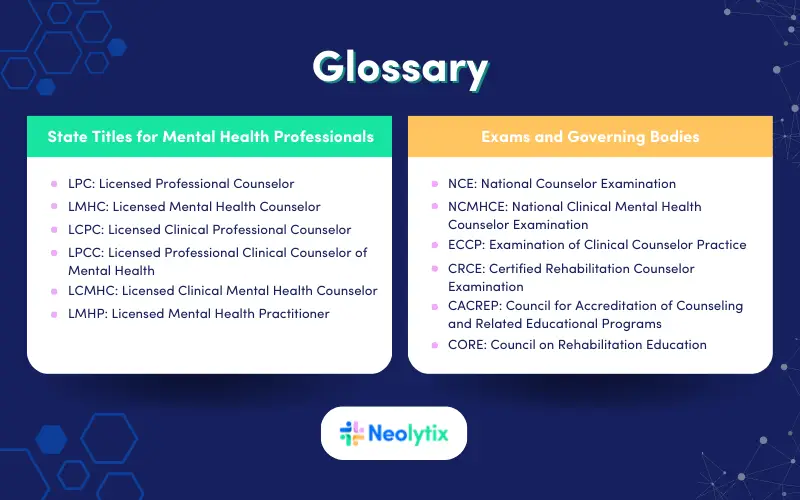
The first and most essential part of insurance credentialing for therapists would be to obtain a medical license. Every state, including Washington D.C. and Puerto Rico, requires licensure to legally practice as a professional counselor.
These laws establish therapist’s and counselor’s education, examination, and experience requirements.
What Are the Different Titles Of Mental Health Professionals?
Different states recognize various titles for mental health professionals, including:
- LPC: Licensed Professional Counselor
- LMHC: Licensed Mental Health Counselor
- LCPC: Licensed Clinical Professional Counselor
- LPCC: Licensed Professional Clinical Counselor of Mental Health
- LCMHC: Licensed Clinical Mental Health Counselor
- LMHP: Licensed Mental Health Practitioner
While LPC is the most common, these licenses are recognized by different states to indicate a mental health professional.
Education Requirements For Licensed Professional Counselors
Although education requirements vary by state, obtaining a license generally involves completing a master’s degree in counseling. In addition, a certain number of supervised experience hours are necessary to obtain a license.
Most states require:
- +/-60 semester hours of graduate coursework
- 48 semester hours toward a master’s degree.
- 2,000 and 3,000 hours of supervised experience
- A minimum number of face-to-face supervision hours
The counseling graduate program must be accredited, with specific accreditation standards varying by state.
Finally, passing a comprehensive exam is required to complete the training and obtain a license. The exams include:
- NCE: National Counselor Examination
- NCMHCE: National Clinical Mental Health Counselor Examination
- ECCP: Examination of Clinical Counselor Practice
- CRCE: Certified Rehabilitation Counselor Examination
While the NCE is the most common exam, each state may accept different examinations as meeting licensure testing requirements.
To find your state’s accreditation requirements, consult the Council for Accreditation of Counseling and Related Educational Programs (CACREP) at www.cacrep.org.
Related to CACREP, the Council on Rehabilitation Education (CORE) is responsible for accrediting master’s programs in rehabilitation counseling.
Click here for detailed information on state licensure requirements, or use the provided tool to search requirements by state.
What is the difference between licensing and credentialing?
Licensing is the process by which individual practitioners receive official permission to practice their profession, while credentialing is the verification of their qualifications and privileges to provide services at a specific healthcare organization.
Medical credentialing is essential for healthcare professionals to participate in health plan networks, provide care to insured patients, and receive in-network payment for services.
While licensure requirements vary by state, each health plan has its own enrollment requirements. Most carriers have standard forms for credentialing, while others use online applications. The Council for Affordable Quality Healthcare (CAQH) has helped standardize enrollment methods, but there is still variation among carriers.
Tip: Pay close attention to the guidelines of individual health plans when seeking to join their networks. Consider the services you provide, the reimbursement offered by the plan, and the specific populations you plan to serve.
The Credentialing Journey: From Application to Approval
Understanding the Credentialing Process Flow Chart
So, how does the credentialing process work? Picture a process flow chart that starts with collecting your credentials; like your education, licensure, and work history, and ends with you being approved to practice within a healthcare setting. Along the way, these documents are verified through healthcare credentialing services to ensure everything is in order. The next step usually involves a review by a credentialing committee or board, which will determine whether you meet the standards to provide care. Finally, if all goes well, you’re good to go—whether you’re joining a hospital staff or becoming part of an insurance network, such as with Cigna provider credentialing.
Why Credentialing is Crucial for Providers
Now, you might be wondering, what is provider credentialing really all about? At its core, provider insurance credentialing is about ensuring that only qualified professionals are entrusted with patient care. It’s not just a formality; it’s a safeguard. The process includes detailed checks on your background, qualifications, and professional history to confirm that you’re fully capable of delivering high-quality healthcare. This is why partnering with top-rated credentialing companies is often recommended—they have the expertise to navigate this complex process smoothly, saving you time and reducing the risk of errors.
Insurance Credentialing for Therapists: Credentialing and Enrollment
The terms “credentialing” and “enrollment” are sometimes confused. Let’s clarify these terms.
- What is Provider Enrollment?
“Provider enrollment” can refer to enrolling a healthcare provider with an insurance company. However, it can also involve adding electronic remittance advice (ERA) to electronic health records (EHR) or other aspects of the healthcare billing cycle.
For our purposes, we will focus on “medical credentialing” because “enrollment” has broader meanings in different contexts for different parties.
- What is Medical Credentialing?
Medical credentialing is necessary for healthcare professionals to participate in health plan networks, provide care to insured patients, and receive in-network service payments. While licensure requirements vary by state, each health plan has its enrollment requirements. Most carriers have standard forms for credentialing, and some use online applications.
- Joining A Health Plan’s Network
The CAQH has worked to standardize enrollment methods, but variations still exist among carriers.
When wishing to join a health plan’s network, carefully review the specific guidelines of that plan. Consider the services you offer, the plan’s reimbursement policies, and the target populations you intend to serve.
For instance, state Medicaid programs often cover various provider types, including mental health care, such as primary care providers, clinics, and psychiatric residential treatment facilities. States have specific rules and statutes regarding providers qualified to offer mental health services.
For more information on enrolling in Medicaid as a mental health professional, click here.
Credentialing Differences: Individual vs. Group National Provider Identifier (NPI)
One significant difference to be aware of during the credentialing process is individual NPI versus group NPI for therapists.
- What is an Individual NPI?
Every healthcare provider must obtain a National Provider Identifier number or NPI. This 10-digit number is assigned to each healthcare provider by the Centers for Medicare and Medicaid (CMS).
- What is a Group NPI?
A Group National Provider Identifier (NPI) is a unique 10-digit identification number issued to healthcare providers in the United States by the Centers for Medicare and Medicaid Services (CMS). A Group NPI is assigned to a healthcare provider group, organization, or practice. This can include clinics, hospitals, private practices, and other healthcare entities that provide medical services as a group rather than as individual practitioners.
- Individual NPI vs. Group NPI
Both individual therapists and group practices have their NPIs. Individual therapists use their NPIs as healthcare providers on claims, while group practices use their NPIs as the billing providers.
When beginning the credentialing process, obtaining an NPI, either individually or for the practice, is one of the first steps. However, it’s crucial to provide the correct NPI to the corresponding insurer.
If you are credentialing both a practice and individual providers associated with it, request the insurer to link the individual and group NPIs.
Which insurance panels to credential with?
When selecting companies to partner with and networks to join, understanding your clients and service area is vital. Identify the popular insurance plans in your area and the mental health services they cover. Consider the primary needs of the clients you are likely to serve.
Here are the biggest payers to consider, with links to their respective websites should you require additional details from the individual organization:
If you are unsure about the popular insurance companies in your area, we recommend starting with these major payers. However, keep an eye out for local plans that are popular in your region. Check if the insurance company’s panel is currently accepting practitioners in your area of specialization.
Most major insurance companies require extensive paperwork throughout the medical credentialing process, including completing the CAQH (the online medical credentialing database) and providing personal details. You will need up-to-date information on your education, licensing, training, and experience.
Avoid putting in all this effort only to find out that the insurer does not cover patients in your area!
If you need assistance in finding popular local plans, please let us know!
What is healthcare credentialing and how can it be streamlined to benefit healthcare organizations?
Leveraging the expertise of top-rated credentialing companies that incorporate automated systems can transform provider credentialing from a daunting task into a streamlined process.
By using advanced automated healthcare credentialing systems, the risk of human error is minimized, and the verification process is accelerated, ensuring that providers are credentialed and ready to practice swiftly. This approach is particularly advantageous in large institutions where the sheer volume of therapists or physicians can turn manual credentialing for hospitals into a lengthy and error-prone endeavor.
Whether you’re navigating physician credentialing services or seeking efficient insurance credentialing for providers, automated solutions provide a significant edge. In the broader scope of credentialing healthcare, these systems redefine the credentialing definition in healthcare by setting a new standard of accuracy and efficiency.
Mastering the Essentials of Provider Credentialing
Insurance credentialing for therapists can be complex, time-consuming, and sometimes costly. We hope this guide is a valuable resource for therapists navigating the complex world of insurance credentialing, providing clarity on:
- Licensing requirements
- Credentialing processes
- Considerations when choosing insurance panels.
If you require additional information, please explore our comprehensive medical credentialing resources and credentialing services page or contact us directly by completing the form below.
In addition, if you’re already credentialed and an in-network provider seeking to improve your reimbursement rates, explore our Payor Contract Negotiation service.