

The credentialing process involves healthcare organizations, hospitals, and insurance networks assessing and confirming the qualifications of a physician or any other healthcare professionals. This process is important for everyone, including the facility, the practitioner, and the patients, ensuring that those providing care are qualified for the job.
At Neolytix, we would like to share the physician credentialing checklist that you need to know about for the process.

Understanding Physician Credentialing
Physician credentialing is a formal process that evaluates and confirms the qualifications of healthcare professionals. This critical process ensures that medical practitioners meet the required standards of education, training, and expertise. For healthcare organizations and hospitals, adhering to credentialing requirements for physicians helps ensure compliance, protect patients, and secure appropriate reimbursement from insurance companies.
By implementing a thorough physician credentialing process, healthcare facilities maintain a high standard of care, building trust with both patients and insurers. Credentialing also plays a significant role in preventing legal risks and operational inefficiencies.
The Credentialing Process for Physicians
The credentialing process for physicians involves several key steps, starting with gathering the necessary documentation and submitting applications to the respective healthcare facility or insurance provider. These steps often include verification of the practitioner’s education, certifications, and work history.
Various stakeholders are involved in the provider credentialing process, including healthcare providers, credentialing organizations, and insurance companies. Understanding and meeting provider credentialing requirements is essential to move through the process smoothly.
Why Credentialing is Needed?
Physician credentialing is a mandatory process, but it’s also very important. Here’s why:
- Improves patient trust in the physician.
- Lowers the risk of medical errors.
- Prevents the healthcare facility from losing revenue.
- Supports physician and facility business growth.
- Reduces restrictions by insurance companies related to pre-existing conditions.
- Improves practitioner reputation.
- Increases cost savings.
- Protects healthcare facilities from potential lawsuits.
Physician Credentialing Checklist
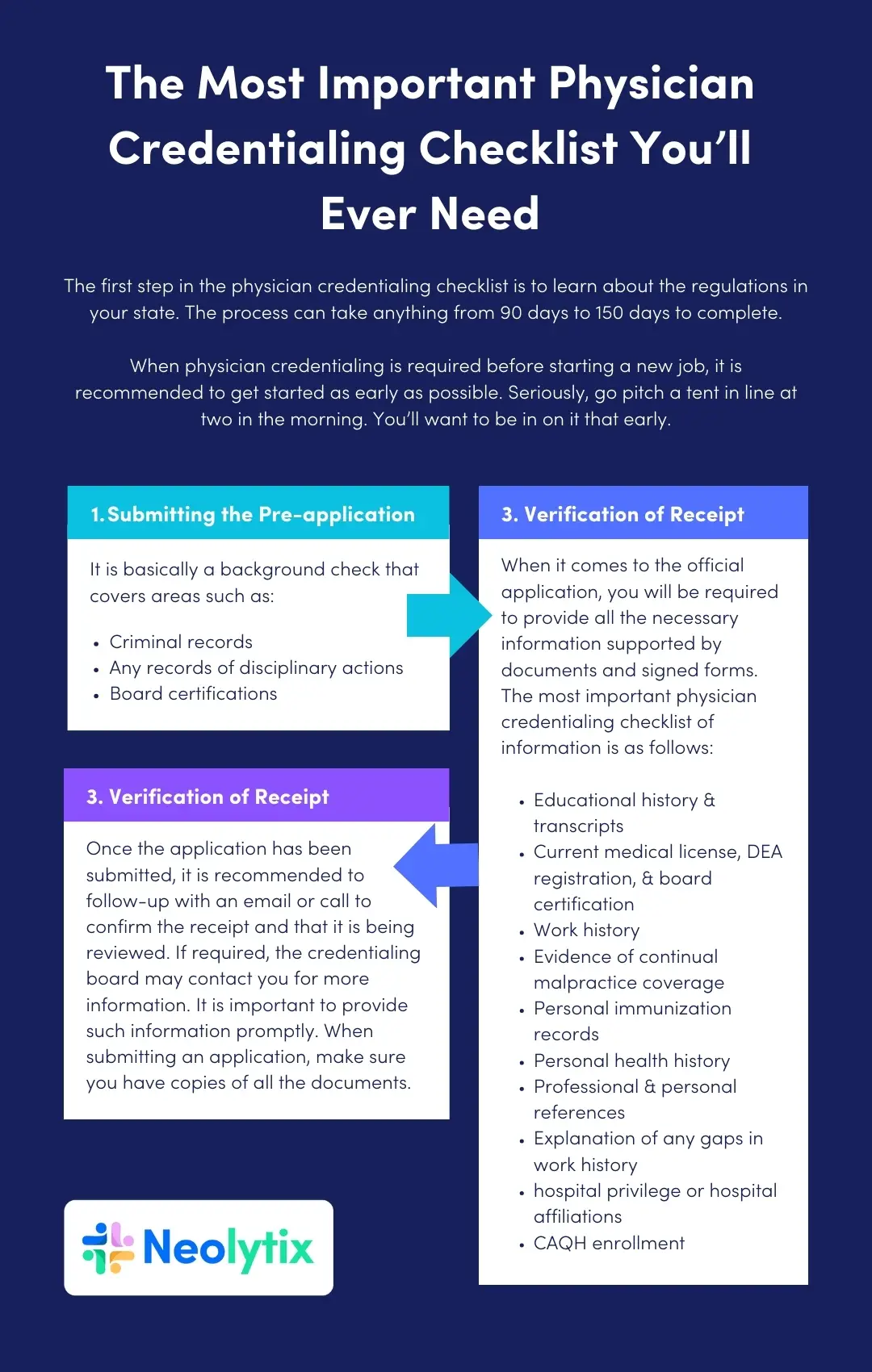
The first step in the physician credentialing checklist is to learn about the regulations in your state. The process can take anywhere from 90 to 150 days to complete. When physician credentialing is required before starting a new role, it is recommended to get started as early as possible.
The most important steps in the process are as follows:
1. Submitting the Pre-Application
Based on the healthcare facility or insurance network, it may be required to submit a pre-application. This step is used to determine whether a physician is qualified and eligible for credentialing. It functions as a background check covering areas such as:
- Criminal records.
- Records of disciplinary actions.
- Board certifications.
If any issues are identified, additional information will be required. If you are qualified, you will move to the next step without issues.
2. Submitting the Credentialing Application
When it comes to the official application, you will be required to provide all the necessary information supported by documents and signed forms.
The core physician credentialing checklist of information includes:
- Educational history and transcripts.
- Current medical license, DEA registration, and board certification.
- Work history.
- Evidence of continual malpractice coverage.
- Personal immunization records.
- Personal health history.
- Professional and personal references.
- Explanation of any gaps in work history.
- Hospital privilege or hospital affiliations.
- CAQH enrollment.
All this information must be backed by copies of relevant documents, letters of recommendation, and a copy of your CV.
Completing the required credentialing application forms is a critical task. Ensuring accuracy and completeness before submission helps avoid delays in the credentialing process for providers.
Submission Guidelines
Adhering to submission guidelines and deadlines is crucial for a successful credentialing process. Make sure to include all required documents as part of the provider credentialing checklist template to prevent delays.
Verification and Final Steps
Once the documents are submitted, it’s important to regularly follow up to ensure everything is progressing on time. A timely response to requests for additional information is key to speeding up the credentialing process for physicians. Any gaps in work history or missing documents should be addressed quickly to avoid setbacks.
For those requiring assistance, Neolytix offers support through the entire physician credentialing process, ensuring that healthcare providers meet all provider credentialing requirements efficiently.
3. Verification of Receipt
Once the application has been submitted, it is recommended that you follow up with an email or call to confirm the receipt and that it is being reviewed. If required, the credentialing board may contact you for more information. It is essential to provide such information promptly. When applying, make sure you have copies of all the documents.
Pre-Application Checklist for Physicians
Before beginning the official application process, it is important to compile all necessary documentation and verify physician credentialing requirements by state. Each state may have unique rules that must be followed, making it crucial to conduct preliminary research to avoid delays. Below is a comprehensive provider credentialing checklist for physicians, designed to help ensure all required information is readily available.
Initial Research and Professional Information
Begin by reviewing the specific credentialing requirements for physicians based on the healthcare facility and insurance company you plan to work with. You’ll need to gather and prepare essential documents:
- Updated CV reflecting all relevant work history and educational background.
- Copies of current medical licenses, DEA registration, and board certifications.
- Hospital privileges and affiliations, as required by the healthcare facility.
Personal Information and Documents
Along with professional credentials, physician credentialing requires personal documents for identity verification and residency proof. These include:
- Government-issued ID (e.g., driver’s license, passport).
- Proof of residency (e.g., utility bill, lease agreement).
Having these documents prepared helps avoid unnecessary delays in the physician onboarding checklist.
Education and Training Documentation
Accurate records of your education and training are crucial when completing the physician credentialing checklist. This section ensures the healthcare facility can verify your qualifications. You’ll need the following:
- Medical school documentation, including your diploma and official transcripts.
- Residency and fellowship completion certificates.
- Contact details for the program directors to facilitate verification.
This step ensures that your academic and training background is thoroughly documented and compliant with physician credentialing requirements by state.
Professional Licenses and Certifications
Credentialing for physicians begins with ensuring that all professional licenses and certifications are up to date. Having the right documentation in place from the start helps avoid delays and sets a strong foundation for the rest of the credentialing process.
State Medical Licenses
When preparing for the credentialing process in healthcare, having copies of current and past medical licenses is essential. To ensure smooth processing, practitioners must verify their license status with the issuing state’s medical board. This is a fundamental part of the provider credentialing process and confirms the professional’s ability to practice in their specialty.
Board Certification
Proof of board certification in the physician’s specialty is required. This demonstrates a commitment to a high standard of care. Documentation for certification maintenance and renewal should also be included.
The accuracy and completeness of these documents are vital, as they form the foundation of what is required when applying to be credentialed at a hospital or with an insurance payer. Ensuring these are ready early in the process simplifies the remaining steps.
Work History and Experience
Verifying employment and clinical privileges is a crucial part of confirming a physician’s qualifications, giving both hospitals and insurers confidence in the provider’s professional background.
Employment Verification
This step requires contact information for previous employers and the submission of letters of recommendation or employment verification letters. Accurate documentation ensures a comprehensive record of the provider’s credentials.
Clinical Privileges
A physician must provide a list of hospitals and clinics where they hold or have held clinical privileges. Documentation of current clinical privileges should be included in the credentialing application.
Malpractice Insurance and Claims History
A physician’s malpractice insurance and claims history are key components of the credentialing process. This section ensures that a physician’s past and present insurance coverage is in place and that any previous claims or lawsuits have been properly documented.
Malpractice Insurance
Proof of current malpractice insurance coverage is required. Include a history of coverage, including previous insurance carriers and policy numbers.
Claims History
A detailed history of any malpractice claims or lawsuits is required. Providing documentation of any resolved claims helps ensure transparency and compliance with NCQA credentialing standards.
These elements are an essential part of ensuring trust and safety within a healthcare setting.
Continuing Medical Education (CME)
CME Credits
Physicians must provide documentation of CME credits earned as part of the credentialing process. This ensures that practitioners maintain their qualifications and stay updated on the latest developments in their field. Certificates of completion for relevant courses should be included in the credentialing checklist.
Professional References
Professional references give peers the opportunity to attest to the competence and character of the physician.
Reference Letters
Letters from peers that attest to the physician’s competence and character must be provided. Contact information for each reference is also required.
Peer Review
Documentation of participation in peer review processes reinforces the physician’s commitment to quality patient care.
Collecting and providing professional references is one of the final steps in provider credentialing, offering a well-rounded view of the physician’s skills, experience, and professional standing.
Health Status and Background Checks
Health Status
Physicians should submit a health clearance form or an attestation of good health, along with immunization records, including TB and flu shots. These documents confirm that practitioners are fit to work in a healthcare environment.
Background Checks
Authorization forms for criminal background checks, along with the results of background checks and drug screenings, must be submitted as part of the credentialing application.
Follow-Up and Monitoring
Application Status
After submitting the application, regular follow-up with the credentialing organization helps monitor progress. Responding promptly to any additional information requests is one of the most effective ways to keep the process on track.
Recredentialing
Maintaining up-to-date records for future recredentialing is essential to ensure compliance with NCQA credentialing standards. Recredentialing helps avoid lapses in a provider’s ability to work and ensures that practitioners continue to meet ongoing requirements. Most payers require recredentialing every two to three years.
By following these steps, physicians can avoid delays and secure approval, making the credentialing process smoother for both the provider and the healthcare facility.
If you’re unsure about any part of the medical credentialing process or need guidance, Neolytix is here to help. With over 14 years of experience supporting healthcare organizations, we’re ready to provide the information and hands-on support you need to streamline your credentialing journey. Explore our credentialing services to learn more.