


Efficient patient access is a core operational driver of clinic performance. Scheduling accuracy, insurance verification, patient intake, and front-office workflows collectively determine how smoothly a clinic operates, how quickly patients are seen, and how reliably revenue is captured.
When patient access services function well, clinics reduce wait times, minimize administrative friction, and free clinical staff to focus on care delivery. When they do not, the impact cascades across operations—missed appointments increase, claims are delayed or denied, and patient satisfaction declines.
For small and mid-sized clinics, the challenge is magnified. Limited staffing, rising patient volumes, and higher patient expectations leave little margin for administrative inefficiency. As a result, many clinics are turning to patient access solutions—particularly virtual medical assistants—as a scalable, cost-effective way to stabilize operations while improving patient experience.
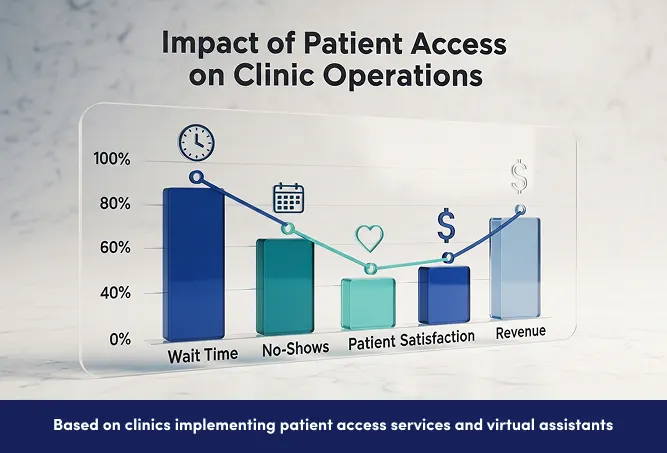
Understanding Patient Access: A Foundation for Better Operations
Patient access services are more than administrative functions—they are strategic tools for improving clinic performance. Clinics that invest in effective patient access solutions can streamline workflows, minimize delays, and improve staff productivity.
Core patient access functions include:
- Scheduling and appointment management: Standardized scheduling workflows reduce errors, optimize provider templates, and improve appointment utilization.
- Insurance verification: Verifying eligibility and benefits in advance reduces claim denials, rework, and delayed reimbursement.
- Patient intake and communication: Accurate data collection, reminders, and pre-visit instructions reduce no-shows and improve visit readiness.
According to Frontiers in Health Services (2025), optimizing these processes directly improves care delivery, patient satisfaction, and clinic throughput. Clinics that neglect these services often face administrative bottlenecks, longer wait times, and reduced patient retention.

Common Patient Access Pain Points for Clinics
Patient access challenges typically fall into two interconnected categories: operational bottlenecks and patient experience gaps. Left unaddressed, these issues compound over time.
Operational Bottlenecks
- Limited appointment slots and inconsistent provider templates create scheduling conflicts.
- Manual insurance verification leads to errors and delayed claims.
- Administrative staff juggling multiple roles increases the likelihood of mistakes and delays.
Patient Experience Gaps
- Missed reminders and unclear instructions cause patients to reschedule or no-show.
- Patients frustrated by long waits or confusing intake processes may seek care elsewhere.
- Poor communication reduces patient satisfaction and can negatively affect retention rates.
A HealthDrive Insights (2024) survey revealed that 60% of clinics report patient access delays as a major operational bottleneck, highlighting the urgent need for streamlined processes and reliable support solutions.
The Financial and Operational Impact of Delayed Access
Delays in patient access are not only frustrating for patients—they also have measurable financial and operational consequences for clinics.
- Revenue Leakage: Missed appointments and delayed eligibility checks reduce collections and disrupt cash flow.
- Operational Inefficiency: Staff must spend additional time rescheduling or correcting administrative errors.
- Patient Churn: Frustrated patients are more likely to seek care elsewhere, reducing lifetime patient value.
Frontiers in Health Services emphasizes that improving access through structured workflow optimization and technology can significantly reduce wait times, improve operational efficiency, and increase patient satisfaction (Frontiers, 2025). Clinics that fail to address access challenges risk accumulating operational losses that far exceed the cost of implementing effective solutions.
How Virtual Medical Assistants Help Improve Access
- 24/7 Scheduling and Appointment Reminders: Automated systems reduce errors and ensure patients are notified in advance.
- Insurance Eligibility Verification: VMAs verify coverage in advance, reducing denials and payment delays.
- Patient Follow-ups: Proactive outreach improves adherence and reduces no-shows.
- Administrative Support: Front-desk tasks, data entry, and documentation are streamlined, reducing staff workload.
Verified Case Studies: Clinics Achieving Success with Patient Access Services
Case Study 1: IPMG Behavioral Health Practice
IPMG, a behavioral health practice, implemented a virtual medical assistant to support appointment reminders, patient intake, and front-office coordination. The objective was to reduce administrative friction and improve patient communication in a high-volume behavioral health setting.
Verified outcomes from the published case study include:
- Reduced front-desk administrative burden related to intake and appointment coordination
- Improved patient communication consistency through automated reminders
- Enhanced overall patient experience, particularly around scheduling responsiveness
Case Study 2: Anderson Family Primary Care Clinic
Anderson Family Primary Care Clinic partnered with Remote Medical Assistant LLC to deploy a virtual assistant for insurance verification, appointment scheduling, and patient follow-ups. The clinic aimed to stabilize front-desk operations and reduce staff overload during peak patient volumes.
Verified outcomes from the published case study include:
- Faster insurance verification and patient onboarding workflows
- Reduced workload for in-office administrative staff
- Improved scheduling efficiency, allowing staff to focus more on in-clinic patient care
Case Study 3: Family Medicine Practice with RekhaTechLLC Virtual Assistant
A mid-sized family medicine practice implemented a RekhaTechLLC virtual assistant to manage scheduling coordination and insurance verification tasks. The goal was to improve access workflows without expanding internal staffing.
Verified outcomes from the published case study include:
- Improved appointment adherence due to consistent reminder workflows
- Higher patient retention attributed to smoother access and follow-up processes
- Increased operational efficiency across scheduling and verification activities
These real-world examples demonstrate that patient access services, supported by virtual assistants, deliver measurable operational and financial returns when implemented strategically.

Conclusion
Patient access for clinics has evolved from an administrative necessity into a strategic lever for operational excellence, patient satisfaction, and revenue growth. Clinics can achieve measurable results by:
- Streamlining scheduling and intake processes
- Leveraging virtual medical assistants for administrative efficiency
- Proactively addressing bottlenecks that drive delays and no-shows
Investing in patient access services enables clinics to operate efficiently, improve patient experience, and ensure staff time is spent on care delivery—not administrative recovery.

Frequently Asked Questions
What are patient access services for clinics?
Patient access services manage scheduling, insurance verification, and patient intake to streamline clinic operations and improve the patient experience.
How do virtual medical assistants help clinics improve patient access?
Virtual medical assistants automate appointment reminders, patient intake, and insurance checks, reducing administrative workload and increasing operational efficiency.
Can patient access services reduce missed appointments?
Yes. Clinics using patient access solutions or virtual assistants see fewer no-shows, faster onboarding, and improved appointment adherence.
Are virtual medical assistants cost-effective for small clinics?
Absolutely. Pocket-friendly VA services provide scalable administrative support, helping small and mid-sized clinics optimize operations without hiring full-time staff.
What governance practices should be budgeted for in 2026?
Include ongoing model validation, compliance monitoring, ethical frameworks, and risk mitigation processes.