


In the evolving healthcare technology landscape, U.S. health systems must align AI investments with measurable operational outcomes, automate administrative workflows, and build digital workforce capabilities to stay financially and clinically competitive in 2026.
Why 2026 Tech Budgets Must Be Strategy-First, Not Tool-First
Leaders can no longer allocate technology budgets based on the latest buzz. In 2025, U.S. health systems saw substantial increases in AI adoption and spending, with healthcare AI investments reaching approximately $1.4 billion and growth of domain-specific AI tools more than sevenfold compared to previous years. Health systems lead this adoption at 27 %, significantly higher than outpatient providers (18 %) and payers (14 %). (HC Innovation Group)
What this means for budgeting:
- Prioritize solutions with documented ROI within 6–12 months
- Shift from exploratory pilots toward mission-critical workflows
- Align spend with measurable operational outcomes such as cost savings, error reduction, and revenue realization
Top AI Investment Areas Driving Operational Value
AI has moved decisively beyond proof-of-concept. In 2025, health systems concentrated investment in areas where impact is quantifiable and scalable.
1. Clinical Documentation & Coding Automation
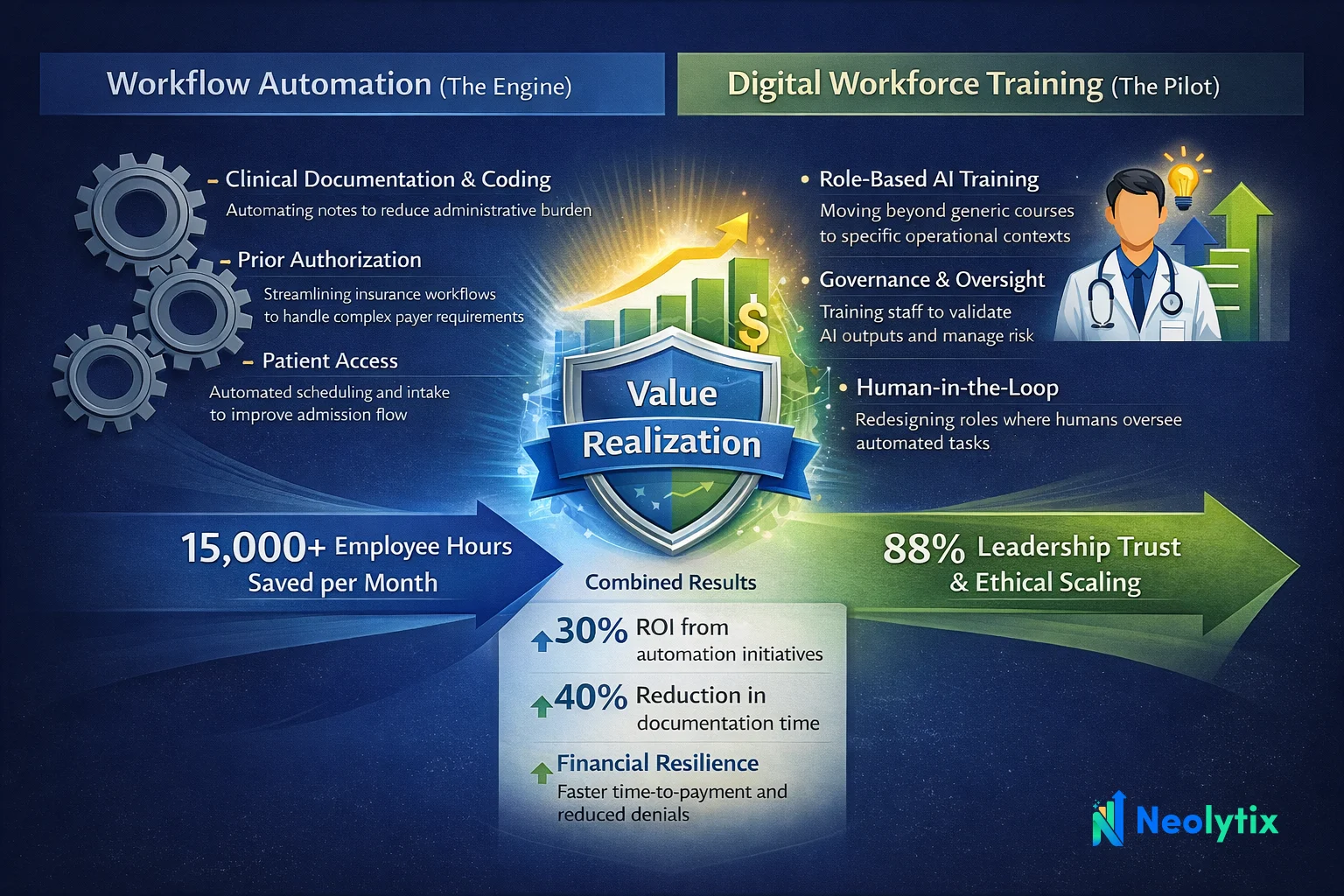
AI-enabled documentation and coding tools reduce clinician administrative burden while improving coding accuracy. By accelerating note creation and enhancing code capture, these systems directly influence productivity, compliance, and downstream revenue cycle performance. (HC Innovation Group)
2. Prior Authorization & Insurance Workflows
Automation and AI-assisted workflows for prior authorization have expanded rapidly as health systems contend with increasing payer complexity. Guided workflows and intelligent document processing reduce delays, minimize denials, and alleviate administrative bottlenecks. HC Innovation Group
3. Patient Access Optimization
Automation across scheduling, intake, and benefits verification improves patient throughput and experience while strengthening the front end of the revenue cycle—an area where small inefficiencies compound quickly into revenue leakage. HC Innovation Group
Collectively, these use cases demonstrate where AI spend translates into measurable operational ROI and supports enterprise performance indicators.

Budgeting for a Digital Workforce: Training & Role Redesign
Technology alone does not deliver outcomes. Sustainable AI value depends on a workforce equipped to use, oversee, and govern intelligent systems.
Industry investment in workforce readiness is accelerating. For example, a new AI credentialing program for healthcare professionals—funded by Adtalem and Google Cloud and launching in 2026—reflects growing recognition that AI literacy is now an operational requirement, not a specialization. (Reuters)
Budgeting tips for workforce readiness:
- Allocate funds for role-based AI training, not generic technology courses
- Invest in governance training for those overseeing model use, compliance, and risk
- Redesign job descriptions to incorporate human-in-the-loop workflows
This shift reflects a broader industry understanding that AI succeeds when staff are equipped to use and oversee it effectively.
Embedding Governance & Risk Management into Tech Budgets
Responsible AI deployment requires built-in governance and risk controls. According to an EY US trends report, 88 % of healthcare leaders trust AI technologies, but effective governance is a critical success factor as organizations scale beyond experimentation. (EY)
Governance investments should include:
- AI output validation checkpoints
- Data privacy and regulatory compliance controls
- Ongoing model performance monitoring
- Ethical use standards aligned with regulatory expectations
Without explicit governance line items, AI initiatives face increased risk of compliance delays, adoption friction, and diminished ROI.
Practical Automation Investments That Reduce Cost & Increase Efficiency
Automation continues to generate tangible value in areas dominated by repetitive, high-volume tasks. U.S. healthcare organizations deploying Robotic Process Automation (RPA) and AI-driven document processing report significant efficiency gains.
One healthcare revenue cycle organization processing millions of documents achieved: over 15,000 saved employee hours per month, 40 % reduction in documentation time, and a 30 % ROI from automation initiatives. (Business Insider)
Effective automation budgeting focuses on:
- High-volume, rules-based administrative workflows
- Clear measurement of time savings and error reduction
- Integration of automation with human oversight
This balanced approach preserves care quality while unlocking operational agility.
Measuring Success: Operational KPIs for 2026 Tech Budgets
To ensure accountability, health systems should embed performance measurement directly into technology budgets. Key KPIs include:
- Documentation time saved
- Denial and appeal rate reduction
- Time-to-payment cycle improvement
- Staff productivity gains
- Patient throughput and access efficiencies
These metrics anchor budgets in business outcomes, not tech adoption alone.
Read More – Planning Healthcare Strategy 2026: Learning from 2025’s Pivotal Shifts in Healthcare Operations
Conclusion
As 2026 planning accelerates, health systems must adopt a workflow-first budgeting framework—one that aligns AI, automation, and workforce readiness with measurable operational and financial outcomes. Organizations that take this approach will reduce risk, improve performance, and accelerate value realization across the enterprise.
At Neolytix, we help U.S. healthcare organizations plan and deploy technology investments that balance efficiency, compliance, and measurable outcomes. Our approach blends AI-driven automation with deep healthcare domain expertise — ensuring budgets focus on value-realized workflows, not costly pilots. Whether you’re optimizing revenue cycle performance or building governance infrastructure for AI operations, Neolytix supports strategic adoption that aligns with organizational goals.

Frequently Asked Questions
How should U.S. health systems budget for AI technologies in 2026?
Budget based on defined operational ROI, implementation timelines, KPIs, and governance requirements—rather than feature sets or vendor claims.
What are the most impactful areas for automation investment?
Prioritize workflows with high volume and repetitive tasks such as billing, documentation, patient access, and prior authorization.
Why is workforce training essential for AI success?
AI delivers value only when staff are equipped to use, oversee, and govern it—driving adoption while minimizing operational and compliance risk.
How can leaders measure AI and automation success?
Track outcomes like time-saved, reduction in errors, throughput improvements, and financial metrics directly tied to operational performance.
What governance practices should be budgeted for in 2026?
Include ongoing model validation, compliance monitoring, ethical frameworks, and risk mitigation processes.