


When a newly hired provider joins your organization, two clocks start simultaneously. The first is payroll which is immediate, predictable, and already built into your budget. The second is revenue and for most healthcare organizations; no one can tell you when it actually begins.
Ask your credentialing team when a new provider will be billing, and the answer is almost always some version of “somewhere in Q2” or “we’re working on it.” That answer isn’t evasion. It reflects a structural gap at the center of how provider credentialing is currently managed: the tools organizations rely on track where applications are, not when revenue starts.
For CFOs modeling provider ramp, COOs aligning staffing to capacity, and talent acquisition leaders who made a start-date promise during recruitment; that gap is not an administrative inconvenience. It is a material planning failure, and it costs more than most organizations account for.
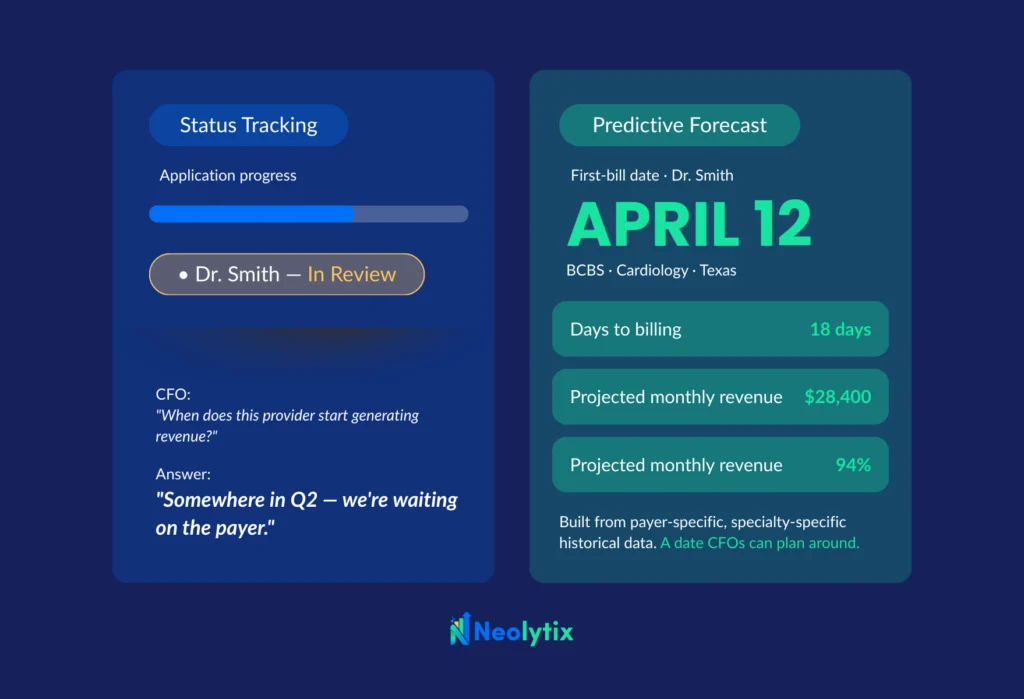
Status Tracking and Revenue Forecasting Are Not the Same Problem
Real-time credentialing dashboards have become standard across most credentialing platforms. On the surface, they appear to solve the visibility problem. In practice, they solve a different problem entirely.
A status update tells you that an application is “in payer review.” It tells you nothing about when that review will conclude. An application marked “in review” on day 20 is visually identical to one marked “in review” on day 80. The dashboard registers activity. It does not register trajectory.
Revenue forecasting requires something the status update cannot provide: a projected completion date specific enough to build a financial plan around. Not a range. Not a stage. A date.
These two requirements, knowing where an application is and knowing when a provider will bill, demand fundamentally different data inputs. Status visibility needs an activity log. Revenue predictability needs historical performance data: how long this payer, in this state, for this specialty, has taken to approve applications in the past. Most credentialing operations have the first. Almost none have the second.
The Number That Exposes the Real Problem
The standard credentialing timeline is cited across the industry as 90 to 120 days. That figure is accurate as an average and nearly useless as a planning input.
A sample of 1,000 commercial payer credentialing applications tracked by nCred showed an average completion time of 64 days, with the fastest taking 21 days and the slowest taking 201 days. That 180-day spread between best and worst case is not a rounding error. It is the range within which every quarterly revenue projection must somehow operate.
Physicians and surgeons lose up to $122,144 during a 120-day credentialing delay based on average salary data from the U.S. Bureau of Labor Statistics, according to research by Assured. For specialists, daily revenue losses during credentialing delays can reach $15,000 per provider. These figures represent permanently unrecoverable revenue in most cases — commercial payer timely filing limits close the retroactive billing window before most organizations realize the full scope of exposure.
For a medical group onboarding ten providers annually, even a conservative average delay compounds into seven figures of revenue that was budgeted, expected, and never arrived.

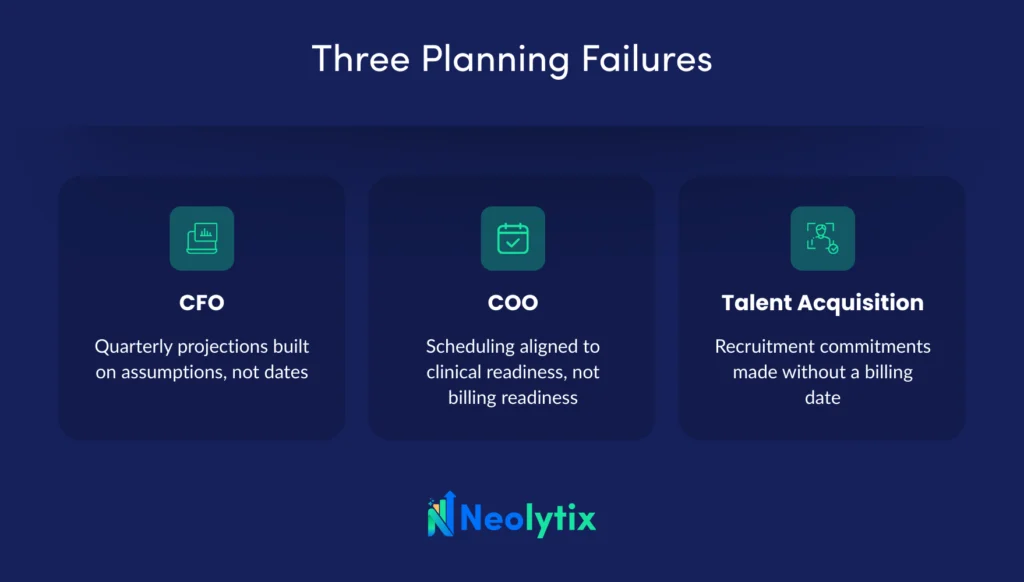
Three Planning Failures Credentialing Uncertainty Produces
The absence of a reliable revenue start date does not just affect the credentialing team. It fractures planning across three organizational functions simultaneously.
For CFOs and finance teams, the problem shows up in quarterly projections built on assumptions rather than data. Staffing costs are concrete and immediate. Revenue activation is undefined. The result is a recurring margin compression that appears on the P&L without a clear cause — because credentialing uncertainty has no line item of its own.
For COOs and Medical Staff Services directors, provider scheduling and capacity planning are built around clinical readiness rather than billing readiness. A provider cleared to see patients is not the same as a provider cleared to bill. Organizations that treat these as equivalent discover the difference when claims deny and the revenue that was supposed to arrive in week six is still pending in week fourteen.
For talent acquisition leaders, the gap surfaces as a credibility problem. Recruitment conversations involve commitments about when providers will be productive members of the organization. Those commitments are made without a credentialing date to support them — because no one has one. When the billing start date slips, it is not just a revenue problem. It is a provider experience problem that affects retention and future recruitment.
When a provider is hired, finance teams model expected revenue ramp based on clinic schedules, payer mix, and historical reimbursement — projections that assume a predictable transition from clinical readiness to billing readiness. Credentialing breaks that assumption.
What Drives Timeline Variation — And Why It Cannot Be Read from a Status Field
Credentialing timelines are not uniformly unpredictable. They are predictable — but only when analyzed at the right level of granularity.
A commercial payer credentialing for a behavioral health provider in Texas operates on a different processing cadence than the same payer credentialing for an orthopedic surgeon in California. Medicare enrollment for a primary care physician in Ohio moves on patterns distinct from multi-state credentialing for a hospitalist. Payer committee meeting schedules, state-specific documentation requirements, specialty-level application complexity, and supervisory agreement requirements for PA/NP-heavy organizations all produce measurably different completion timelines.
None of these variables appear in a status field. “Application submitted” and “in payer review” carry no information about which of these patterns applies to a given file — and therefore carry no information about when that file will close.
Organizations that have built payer-specific, state-specific, and specialty-specific completion benchmarks from their own historical data can replace range estimates with date-level forecasts. The difference is not incremental. “Dr. Smith will be billing by April 12” is a planning input. “Somewhere in Q2” is not.
What Credentialing Predictability Actually Requires
Moving from status visibility to revenue predictability is not primarily a technology change. It is an operational data discipline.
It requires capturing completion time at the payer-state-specialty level across every credentialing cycle — not just tracking that applications were submitted and approved. It requires pre-submission risk review that flags delay-generating conditions before an application reaches a payer queue, when intervention can still protect a revenue date. It requires proactive milestone management that identifies when an application is not progressing at the expected rate for its particular combination of variables — and routes intervention accordingly.
When enrollment teams are embedded within the revenue cycle team, health systems gain visibility into critical metrics like first-time denials and cash flow impact, allowing them to quickly course-correct when issues arise and leading to better financial predictability and stronger payer relationships.
The output of this operational model is not a better status dashboard. It is a revenue forecast — a projected first-bill date per provider, with a confidence level built from actual performance data, that CFOs can use to model quarterly projections, COOs can use to align scheduling to billing reality, and talent acquisition teams can use to make commitments they can keep.
That is what provider credentialing predictability means in practice. Not faster credentialing. Not more visible credentialing. Credentialing that answers the question the organization is actually asking: when does revenue start?
From Status Updates to Revenue Certainty
Most credentialing platforms were built to track work. InCredibly was built to forecast revenue.
By combining AI-driven workflow automation with predictive timeline modeling, InCredibly delivers a date-specific billing forecast for every provider in your pipeline — not a progress bar, not a stage update, but a date. The platform learns payer patterns, captures state-specific requirements, and flags delay risks before they reach a payer queue, so the answer to “when will Dr. Smith bill?” is “April 12” — backed by data, not a guess.
For CFOs who need a cash flow forecast. For COOs who need scheduling aligned to billing reality. For talent acquisition leaders who need a start date they can commit to.

Frequently Asked Questions
What is the difference between credentialing status tracking and credentialing predictability?
Status tracking shows where an application is in the process — submitted, in review, approved. Credentialing predictability forecasts when a provider will reach first-bill status, based on historical payer, state, and specialty performance data. Status answers “what stage?” Predictability answers “what date?”
Why can't real-time credentialing dashboards tell CFOs when revenue will start?
Real-time dashboards reflect activity logs — they show that steps have occurred, not how long remaining steps will take. Forecasting a completion date requires historical pattern data specific to the payer, state, and provider specialty. Most credentialing platforms capture status; they do not capture or model this performance data.
How does payer type affect credentialing timeline predictability?
Medicare enrollment via PECOS typically runs 40–60 days. Commercial payer timelines average 90–120 days but vary considerably by plan and state. Behavioral health payers and multi-state Medicaid programs can extend to 180 days or beyond. Predictive forecasting requires benchmarks by payer, not industry averages.
What metrics should CFOs request from credentialing teams to support revenue forecasting?
Average days-to-first-bill by payer and specialty, projected revenue recognition date per active provider, revenue at risk quantified by current pipeline delays, and a flag list of applications at elevated delay risk with expected impact on billing dates.
How does supervisory agreement management affect credentialing predictability for PA/NP-heavy organizations?
For organizations where physician assistants and nurse practitioners represent the majority of clinical staff, supervisory agreement lapses create billing interruption risks that sit outside the standard credentialing workflow. Organizations that do not track these independently face unplanned revenue disruptions that appear without warning — a predictability gap that compounds the core enrollment uncertainty.