


A credentialed provider who cannot bill is a financial liability. Every day a newly hired physician waits for payer approval which costs a healthcare organization an estimated $10,000 in lost revenue — a figure cited consistently across industry research. For organizations managing dozens or hundreds of providers, those delays multiply fast.
More healthcare organizations are turning to a credentials verification organization, a CVO, to take this function off their plate entirely. But what that partnership actually involves, and whether it’s the right call for your organization, depends on factors most introductory content skips over. This article covers them plainly.
What Is a Credentials Verification Organization (CVO)?
A credentials verification organization, or CVO, is an independent entity that verifies the qualifications of healthcare providers on behalf of other organizations. According to the National Committee for Quality Assurance (NCQA), a CVO is formally defined as “an organization that conducts primary source verification of practitioner credentials for other organizations.”
In practice, CVO services operate as an extension of a healthcare organization’s credentialing team. They centralize data collection, conduct primary source verification, and support ongoing monitoring — so the client organization can maintain compliance and streamline provider onboarding without building that infrastructure in-house.
A CVO does credentialing full-time, with established relationships with licensing boards, medical schools, certification bodies, and payers. That institutional expertise is difficult and expensive to replicate internally. The key distinction is specialization.
What Does a CVO Verify?
The CVO process covers a broad set of credential elements, verified against original issuing sources rather than self-reported documents. A standard primary source verification (PSV) file typically includes:
- Medical education and training (degrees, residency, fellowship)
- Current state licensure, confirmed active and in good standing
- Board certification status
- DEA registration (where applicable by specialty)
- Work history, including employment gaps
- Malpractice insurance and claims history
- Sanctions, exclusions, and disciplinary actions via the OIG exclusion list, SAM, and the National Practitioner Data Bank (NPDB)
- Sex offender and abuse registries
The result is a verified, current provider record that meets payer and regulatory standards — and one that protects the organization from practitioners with falsified credentials, lapsed licenses, or unresolved disciplinary history.
Understand the full scope of what gets verified: Credentialing vs. Provider Enrollment: What’s the Difference?
What Is the Purpose of a CVO?
The CVO process covers a broad set of credential elements, verified against original issuing sources rather than self-reported documents. A standard primary source verification (PSV) file typically includes:
- Medical education and training (degrees, residency, fellowship)
- Current state licensure, confirmed active and in good standing
- Board certification status
- DEA registration (where applicable by specialty)
- Work history, including employment gaps
- Malpractice insurance and claims history
- Sanctions, exclusions, and disciplinary actions via the OIG exclusion list, SAM, and the National Practitioner Data Bank (NPDB)
- Sex offender and abuse registries
- Revenue A provider cannot bill for services until credentialing and payer enrollment are complete. Given that standard credentialing timelines range from 60 to 120 days, and that errors or incomplete documentation can push that timeline to six months or beyond, the revenue implications are substantial. A 2026 survey by Intelliworx found that more than four in ten healthcare organizations lose up to $50,000 in missed billings every month due to credentialing delays and one in four organizations loses $1 million or more annually.
- Patient safety.Credentialing ensures that every provider interacting with a patient has the verified education, training, and licensure to do so competently. Without rigorous verification, organizations risk employing practitioners with falsified credentials, unresolved disciplinary histories, or lapsed licenses.
- Regulatory and payer compliance.Healthcare organizations must credential providers against standards set by CMS, The Joint Commission, NCQA, URAC, and state-level bodies. Non-compliance can jeopardize accreditation status,Medicare and Medicaid participation, and expose the organization to litigation, civil monetary penalties, and malpractice liability.
Why Ongoing Provider Monitoring Is Part of the CVO Process
A point consistently underemphasized introductory CVO content and one that distinguishes mature CVO partnerships from transactional one, is that credentialing does not end at initial verification.
Recredentialing is required by most payers every two to three years. It re-verifies licensure, updates malpractice history, and reflects any changes in clinical privileges or training. Organizations that manage this proactively avoid lapses that can temporarily suspend billing rights — an easily preventable but surprisingly common revenue disruption.
Beyond recredentialing cycles, continuous monitoring is the current standard for high-functioning credentialing programs. CVOs monitor live databases for new sanctions, license suspensions, exclusions, and disciplinary actions against currently practicing providers. This matters because a provider’s status can change at any point between credentialing cycles. A license suspension or OIG exclusion that goes undetected between reviews can expose an organization to claims for services rendered by an ineligible provider — a liability that can trigger repayment demands, audit findings, and reputational harm.
The Joint Commission provides its own guidelines for ongoing provider performance evaluation (OPPE), which include chart reviews, peer reviews, and patient feedback — complementing the database monitoring a CVO provides.
A full-service healthcare CVO handles both the initial credentialing file and the ongoing monitoring cadence, ensuring that an organization’s provider roster stays compliant between enrollment cycles, not just at them.

Why Partner with a Healthcare CVO? The Advantages
According to industry research, 45% of credentialing teams report staffing levels that are inappropriately low, while 84% experience end-to-end turnaround times of 15 days or more — with revenue leakage averaging $10,000 per day when providers cannot bill.
A credentialing verification organization offers what most in-house teams cannot: dedicated capacity, institutional knowledge, and purpose-built systems that reduce error and accelerate timelines. The Joint Commission formally recognizes CVOs as an approved method of primary source verification, giving their output regulatory standing that matters when organizations face audits or accreditation reviews. For organizations at or past their credentialing capacity, that combination makes a CVO partnership less a vendor decision and more an operational necessity.
The advantages of outsourcing are concrete:
Speed. CVOs use automated workflows and established primary source relationships to move faster than most internal teams. Where a hospital might take two to three months to credential a new specialist manually, a CVO with the right technology and payer relationships can compress that timeline significantly.
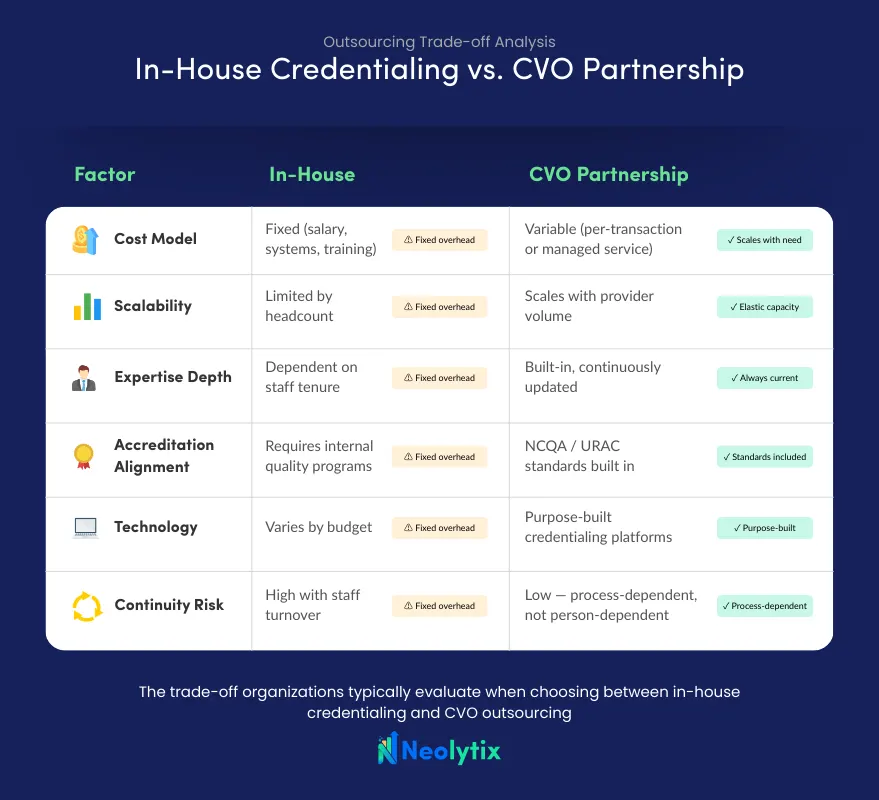
Cost reduction. In-house credentialing requires dedicated staff, database subscriptions, ongoing training, and management overhead. Outsourcing replaces that fixed cost with a scalable per-transaction or managed service model.
Accuracy and compliance. Standardized processes aligned to NCQA and URAC standards reduce the errors that lead to claim denials, audit flags, and re-credentialing delays. Neolytix’s CVO services deliver a 99.2% application approval rate across more than 8,000 processed providers.
Scalability. Organizations can expand or contract provider networks without credentialing capacity becoming the bottleneck — particularly valuable for medical groups, telehealth companies, and ASCs in growth mode.
Focus. Administrative resources freed from credentialing can be redirected to patient care, revenue cycle management, and strategic priorities — a meaningful reallocation in organizations where credentialing teams already spend 20 to 40 hours per week chasing paperwork.
Not sure whether to keep credentialing in-house or outsource it? Read our full breakdown: The Credentialing Dilemma: In-House vs. Outsourced
Things to Consider Before Hiring a CVO
Choosing the right CVO is a significant operational decision. Consider the following before signing a contract:
- Track record and experience. Has the CVO credentialed providers in your specialty mix and care setting? Experience across hospital systems, medical groups, telehealth, and ambulatory surgery centers is not interchangeable.
- Accreditation status. Is the CVO NCQA-certified or URAC-accredited? Both require ongoing re-evaluation, so verify current standing rather than relying on past certification.
- Data security. Credentialing files contain highly sensitive provider information. Confirm the CVO has clearly documented security protocols and compliant data management practices.
- Technology and integration. Does the CVO’s platform integrate with your EHR, practice management system, or credentialing software? Real-time dashboards and status tracking reduce the back-and-forth that slows workflows.
- Customization. Every organization has a different payer mix, provider volume, and compliance posture. A CVO that offers a templated, one-size-fits-all approach may not serve your specific needs effectively.
- KPIs and reporting. Ask upfront what metrics will be tracked and how performance will be measured. Time-to-credentialing, first-pass approval rate, and expirables compliance are all meaningful indicators of CVO performance.
Ready to explore what a managed CVO partnership looks like for your organization? Explore Neolytix CVO Services
The Bottom Line
CVO credentialing is not an administrative convenience; it is a revenue and compliance function that directly affects provider onboarding speed, payer enrollment outcomes, and organizational risk exposure. As credentialing demands continue to outpace in-house capacity across U.S. healthcare organizations, the question is less whether to work with a CVO and more which partner is right for your organization.
For healthcare executives evaluating options, the framework is straightforward: look for accredited, experienced, technology-enabled CVOs with transparent performance metrics and a track record in your specific care environment.
Neolytix’s CVO services, supported by the InCredibly, are built for exactly this. Whether you’re onboarding a single provider or managing a roster of hundreds across multiple payers, InCredibly gives your team real-time visibility into credentialing status, enrollment progress, and compliance exposure — so revenue activation is a timeline you can plan around, not guess at.

Frequently Asked Questions
What does CVO stand for in healthcare?
CVO stands for Credentials Verification Organization. It is an independent entity that verifies the qualifications of healthcare providers — including their education, licensure, board certifications, malpractice history, and sanctions status — on behalf of hospitals, health systems, medical groups, health plans, and other healthcare organizations.
What is the difference between a CVO and an in-house credentialing team?
An in-house credentialing team manages verification internally using its own staff, systems, and database subscriptions. A CVO is an external partner that performs the same functions using specialized infrastructure, established primary source relationships, and accreditation-aligned workflows. CVOs offer greater scalability, continuity, and compliance consistency — particularly valuable when provider volume grows or internal staff turnover is high.
How long does the CVO credentialing process take?
The standard credentialing timeline ranges from 60 to 120 days, depending on the payer, provider specialty, state of licensure, and completeness of the application. Multi-state credentialing or complex provider backgrounds can push timelines to six months or beyond. Working with a CVO that uses automated workflows and pre-established payer relationships can meaningfully compress this window.
What accreditations should a CVO have?
The two recognized accreditation bodies for CVOs in the U.S. are the National Committee for Quality Assurance (NCQA) and the Utilization Review Accreditation Commission (URAC). Both require CVOs to undergo rigorous evaluation and renew accreditation every three years. When selecting a CVO, verify their current accreditation status directly — not from marketing materials — as past certification does not guarantee active standing.
What types of healthcare organizations use CVO services?
CVO services are used across acute and non-acute settings, including hospitals and health systems, medical groups, independent practice associations (IPAs), ambulatory surgery centers, telehealth companies, federally qualified health centers (FQHCs), home health agencies, skilled nursing facilities, and health plans. Any organization that employs, contracts, or networks with licensed healthcare providers has a credentialing obligation that a CVO can support.
Does a CVO handle provider enrollment with payers?
Some CVOs offer provider enrollment as part of a full-service credentialing package, while others focus solely on primary source verification. Full-service CVO partners like Neolytix handle both credentialing and payer enrollment as complementary, parallel processes, which reduces the total time from application to first billable claim.
What happens if a provider's credentials lapse between credentialing cycles?
If a license, board certification, or malpractice policy lapses and goes undetected, the provider may be billing for services while technically ineligible — creating repayment liability, audit exposure, and potential accreditation risk for the organization. This is why ongoing monitoring is a critical component of a complete CVO credentialing system, not just an optional add-on. A CVO with continuous monitoring capabilities tracks expirables and flags status changes in real time, not just at the next recredentialing cycle.
How do I know if my organization is ready to outsource to a CVO?
Common indicators include: credentialing timelines consistently exceeding 90 days, recurring claim denials tied to enrollment or credentialing errors, high staff turnover in the credentialing function, rapid provider onboarding growth, or multi-state expansion with varying licensure requirements. If any of these apply, a CVO assessment is worth pursuing.