


Medicare Advantage plans across the U.S. increasingly meet CMS network adequacy requirements on paper. Provider counts, geographic coverage, and specialty distribution often pass regulatory thresholds. Yet in 2025, CMS oversight bodies and beneficiary advocacy organizations documented a persistent problem: patients still struggle to access care—even within “compliant” networks.
This is not a failure of enforcement. It is a structural gap between network adequacy compliance and operational access, where provider credentialing services and enrollment execution play a critical but often overlooked role.

CMS Network Adequacy Measures Network Structure—Not Appointment Access
CMS network adequacy standards are designed to evaluate whether a Medicare Advantage plan has sufficient network structure to serve its members. These standards evaluate:
- Provider-to-member ratios
- Time and distance requirements
- Specialty availability by geography
They do not assess whether a patient can actually schedule an appointment.
In its 2025 Contract Year policy and technical updates, CMS maintained a clear distinction between:
- Network adequacy attestations, and
- Provider directory accuracy requirements (CMS Final Rule, 2025).
Notably, CMS did not finalize any requirement obligating plans to verify whether listed providers are actively seeing patients, accepting new Medicare Advantage members, or operationally available for scheduling.
Operational implication:
A plan can meet every CMS adequacy benchmark while patients encounter appointment delays, closed panels, or unavailable providers.
Provider Directories Remain a Weak Proxy for Real Access
In 2025, the HHS Office of Inspector General (OIG) published findings showing that many Medicare Advantage provider directories include inactive or unavailable providers (OIG Report, 2025).
The OIG found that:
- Providers were listed at locations where they no longer practiced
- Some providers were not accepting Medicare Advantage patients
- Others should not have been listed at all
Despite this, these providers were still counted toward network adequacy compliance.
Why this matters
Provider directories are often the primary tool beneficiaries use to find care.
When directory data reflects theoretical participation rather than operational reality, networks appear adequate while access remains constrained.
This is how “ghost networks” form— regulatorily compliant, but functionally inaccessible (OIG, 2025).
CMS Acknowledged Directory-Driven Harm in 2025
CMS’s own actions in 2025 reinforced the seriousness of directory-driven access failures.
During the year, CMS introduced a Special Election Period (SEP) allowing Medicare Advantage beneficiaries to change plans if they enrolled based on incorrect provider directory information (CMS beneficiary guidance, 2025). This policy response was corrective, not preventive—implemented after evidence showed patients were being misled.
At the same time, advocacy organizations documented ongoing inaccuracies within Medicare Plan Finder data throughout the 2025 enrollment cycle (Medicare Rights Center, 2025).
Regulatory signal:
CMS recognizes that directory inaccuracies undermine access, even when plans remain technically compliant with network adequacy standards.
The Operational Gap CMS Does Not Regulate
What CMS does not regulate is how quickly and accurately providers are operationalized within health system and payer workflows.
This includes:
- Credentialing and payer enrollment timelines
- Provider activation across scheduling, billing, and directory systems
- Ongoing provider lifecycle maintenance
In 2025 rulemaking, CMS did not introduce requirements tying network adequacy compliance to:
- Credentialing turnaround time
- Appointment availability verification
- Real-time provider status validation
As a result, access outcomes are largely determined by internal execution.
Why Patients Still Can’t Get Appointments—Even in Compliant Networks
Based on 2025 oversight findings, access failures typically occur when:
- Providers are listed before credentialing and enrollment are complete
- Providers exit practices without timely directory updates
- Panel status changes are not synchronized across systems
These are not regulatory violations. They are operational breakdowns.
CMS enforcement validates structure. Patient access depends on execution.
Operational Accountability Is Now the Access Differentiator
In the absence of appointment-level enforcement, organizations that reduce access friction do so through disciplined operations.
In 2025, access-leading organizations consistently demonstrated:
- Continuous provider data reconciliation
- Credentialing and enrollment status transparency
- Provider lifecycle management beyond annual attestations
These capabilities do not replace compliance. They determine whether compliance translates into care.
Where Neolytix Fits in the Access Equation
CMS network adequacy rules evaluate network structure, not the operational workflows that determine whether providers are accessible in practice.
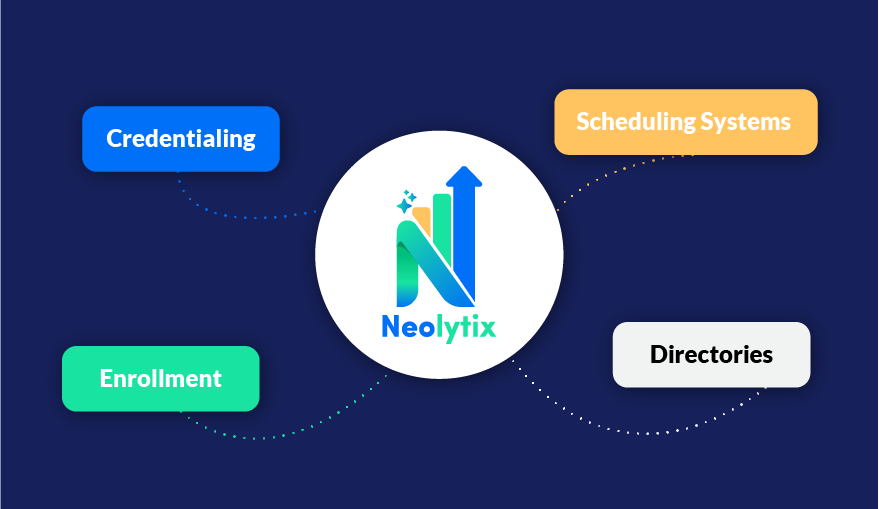
Neolytix supports credentialing and provider enrollment workflows that fall outside direct CMS network adequacy enforcement, including:
- Primary source verification
- Payer enrollment execution
- Revalidation management
- Cross-system provider data coordination
By strengthening these functions, Neolytix helps health systems and managed care organizations address credentialing- and enrollment-related operational gaps that drive the disconnect between compliance and access.
The objective is not to reinterpret CMS rules, but to improve operational execution beneath them.
The Bottom Line for Healthcare Leaders
- Providers are listed before full enrollment completion
- Directory updates lag operational changes
- Credentialing compliance coordination across systems remains manual and fragmented
When credentialing timelines exceed 90 days, provider enrollment delays create appointment capacity gaps—even when directories show provider availability. When enrollment status is not synchronized between billing, scheduling, and directory systems, patients book appointments with providers who cannot yet see them.
CMS does not regulate these workflows directly. But they determine whether network adequacy compliance produces access.

Frequently Asked Questions
Does CMS network adequacy ensure patients can get appointments?
No. CMS network adequacy standards assess provider counts and geography, not appointment availability (CMS, 2025).
Why are inactive providers still listed in directories?
OIG reports in 2025 show provider lifecycle updates often lag operational reality, inflating perceived access.
Did CMS acknowledge directory problems in 2025?
Yes. CMS introduced a Special Election Period for beneficiaries misled by inaccurate directory information.
Are credentialing timelines regulated by CMS network adequacy rules?
No. Credentialing and onboarding speed are not directly regulated under network adequacy standards.
What reduces access gaps today?
Operational accuracy in onboarding, credentialing, and provider data synchronization ensures that network adequacy compliance translates into real-world access.