

Lack of Cost Clarity Is Still Common — Even After the No Surprises Act
In the last two months, new data has reinforced a troubling reality: patient billing across the U.S. still experience overwhelming confusion and surprise charges, despite federal protections. According to a 2025 KFF brief (Nov–Dec 2024 data), nearly 1 in 3 insured adults reported receiving a bill they couldn’t predict or understand—mostly due to unclear benefit details, poor cost estimates, and billing errors.
Patients report being blindsided by charges long after the No Surprises Act passed. Many healthcare organizations cannot yet deliver reliable up-front price estimates for scheduled or ancillary services, creating a persistent “transparency gap.” Recent policy reviews and expert commentaries show that promised cost-transparency protections remain incomplete for some types of planned care and that implementation challenges persist.
For HCOs trying to improve patient satisfaction, reduce A/R days, and protect revenue, modern medical billing services are becoming essential. They bring structure, automation, and clarity to patient-facing billing—something manual or outdated billing workflows simply can’t deliver.
Read More: The Critical Role of Patient Access Services in Improving Clinic Operations

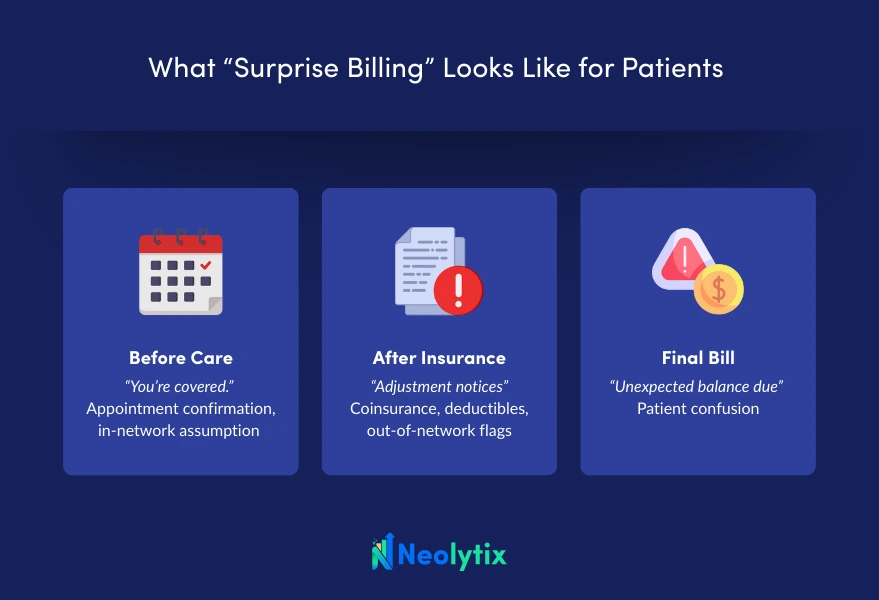
What “Surprise Billing” Looks Like for Patients
- The shock-balance story: “I had no idea my balance was $500 until the bill came.” — a typical reaction that signals a breakdown in upfront estimation.
- Unexpected out-of-network fees after care at an in-network facility.
- Unclear patient responsibility after insurer adjustments and provider reimbursements.
These moments erode trust and make collections harder for healthcare organizations. Recent reporting shows administrative and regulatory friction — including disputes over the independent dispute resolution (IDR) process — that keep costs and outcomes unpredictable for patients.
Why Surprise Bills Hurt Trust — and Collections
1. Broken Expectations Damage Patient Trust
When patients can’t get clear, timely cost information, they feel misled. Trust declines, phone calls escalate, and goodwill disappears — which increases complaints and drives patients away. Experts note that incomplete price-transparency tools continue to frustrate consumers and clinicians alike.
2. Collections Become Harder and More Costly
Patients surprised by bills are less likely to pay promptly. Follow-up calls, appeals, and dispute processes cost time and money. Healthcare organizations see higher collection costs and often incur write-offs when disputes linger or patients lack the means to pay unexpected balances. Recent policy reviews confirm unresolved transparency gaps that directly affect collections performance.
3. Administrative Burden and IDR Friction
Providers and payers are still navigating IDR disputes and eligibility questions, which raises administrative costs and delays final resolution of balances. That confusion can cascade down to the patient, who receives bills while systemic disputes remain open.
How Clear Estimates Prevent Surprises (and Improve Revenue)
- Upfront estimates reduce shock. Offering accurate cost estimates at scheduling or registration sets expectations and increases the likelihood of timely payment. CMS and expert analyses show that better estimation tools are a critical next step for transparency.
- Simple, readable statements lower disputes. Replacing long technical bills with plain-language statements improves patient comprehension and trust.
- Automated estimation reduces administrative error. When estimates are automated from payer data and eligibility responses, they’re less likely to be wrong — shortening collections cycles.
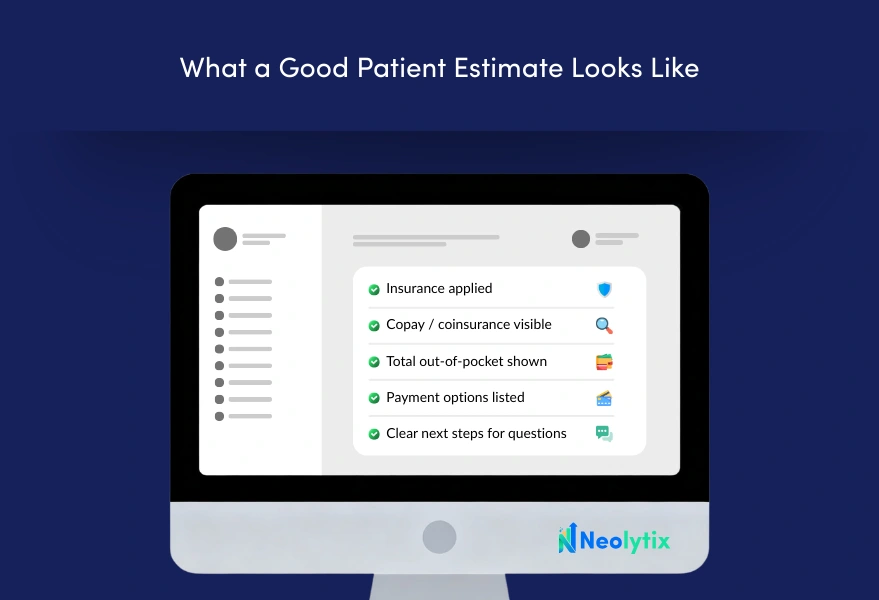
What a Good Patient Estimate Looks Like (quick checklist)
- Applied insurance benefits (covered portion vs. patient responsibility)
- Expected copays, coinsurance, deductibles shown clearly
- Out-of-pocket totals and payment options (instalment, online pay)
- Key disclaimers in plain language (e.g., “Estimate may change if additional services are needed.”)
- Next steps for questions or financial assistance (direct phone/email links)
Accurate estimates are technically feasible today but require clean eligibility data, real-time payer responses, and automated patient-facing tools — capabilities many HCOs are now deploying. Recent industry takeaways highlight the importance of operationalizing these tools across scheduling and registration workflows.
How Neolytix Applies This — Clearer Statements + Better Collections
Neolytix integrates patient access, eligibility verification, and patient communication into its Medical Billing Services, enabling healthcare organizations to provide reliable estimations and clearer statements that patients understand and trust. See Neolytix’s description of patient access services and billing capabilities for details.
What Neolytix does:
- Automates eligibility checks and payer lookups at scheduling.
- Produces clear, easy-to-understand patient estimates and billing statements that reduce confusion and improve transparency.
- Integrates estimates directly into patient portals and billing statements.
- Routes patients to payment plans or financial counseling before a bill surprises them.
Practical Steps HCOs Can Take Today
- Add automated eligibility checks at scheduling. Reduces manual errors and produces better estimates.
- Adopt plain-language statement templates. Test with patients and iterate.
- Offer payment options at point of care. Prepayments or plans reduce downstream bad debt.
- Use analytics to find where surprises happen. Track common denial reasons and mismatch points using dashboards.
The Bottom Line: Clarity Protects Patients and Revenue

Frequently Asked Questions
What causes “surprise billing” even after the No Surprises Act?
Surprise billing persists due to gaps in cost estimation, out-of-network ancillary services, and inconsistent implementation of transparency rules. Operational limitations — not just policy — continue to create patient confusion.
How does lack of billing transparency affect patient trust?
When patients receive unexpected charges, trust erodes quickly. Confusing bills create frustration, increase complaints, and damage long-term patient relationships, even when care quality was high.
How do medical billing services improve upfront cost clarity?
Medical billing services improve cost clarity by automating eligibility checks, calculating patient responsibility earlier, and generating clear estimates before or at the time of care. This reduces confusion and sets realistic expectations.
What should a clear patient cost estimate include?
A clear estimate should show covered amounts, patient responsibility, expected copays or deductibles, total out-of-pocket cost, and payment options — all explained in plain language.
Are transparent billing workflows still HIPAA compliant?
Yes. Transparent billing workflows can be fully HIPAA compliant when patient data is protected through secure systems, access controls, and encrypted communication, while still providing clarity.
How can healthcare organizations reduce surprise billing in 2026?
Healthcare organizations can reduce surprise billing by improving eligibility verification at scheduling, offering clear estimates early, simplifying statements, and aligning billing systems with payer data.