
 Revenue Cycle Management Services
 Medical Billing Services
 Specialized Services
 Operational Finance
 Credentialing (CVO)
 Enrollment & Licensing
 Patient Access & Contact Center
 Authorization & Verification
 Neolytix Growth Services
 Payer Analytics & Contract Strategy
 Workforce & Recruitment
 The Full Lifecycle

 InCredibly
 Operational Dashboards & Reporting
 Integrated Partner Ecosystem

 Multi-Location & Specialty Groups
 Behavioral Health Organizations
 PE-Backed Platforms & MSOs
 FQHCs & Community Health
 Rural RHC


 How We Think / About
 Careers

 Articles
 Billing & Coding Guides
 Case Studies
 Events & Press
 Industry Reports & Benchmarks
 Testimonials
Cardiology & Vascular Surgery Revenue Cycle Management — Built for Surgical Complexity, Not Office Visits
Most billing vendors tell you what your cath lab denied last month. Neolytix tells you which interventional cases are about to bundle, undercode, or breach NCD compliance — and stops them at submission. InCredibly AI combines real-time claim intelligence with sub-specialty coders trained in EP, structural heart, vascular, and IDTF billing.


>96%

40%
<60 days
31
Cardiology Revenue Doesn't Leak — It Hemorrhages
Cath lab cases are the highest-dollar claim events in most medical groups. A single undercoded combination, a missed device C-code, or a bundled procedure surfacing six months later — and the leak compounds before anyone notices.
Up to
Generalist billing teams cannot hold cath lab combined coding, EP CPT families, device reporting, and NCD/LCD compliance in their head at once. That’s where the leak lives.
Trusted by 300+ healthcare organizations nationwide



















Two Kinds of Revenue Leaks. Most Vendors Only Fix One.
Every RCM company talks about clean claims and denial management. Almost none of them look at the contracts those claims are paid against.
Tier 1 · Operational Leaks
The Problems Everyone Knows About
These are the failures every billing vendor promises to fix. Important, but table stakes.
Front-end registration and eligibility errors
Missed insurance verifications, incomplete prior authorizations, and data entry mistakes that trigger avoidable denials before a patient is ever seen.
Undercoding that never shows up on a denial report
Without specialty-specific coding expertise, practices routinely bill at lower complexity levels than the documentation supports. The revenue loss is invisible.
Reactive denial management
Most billing vendors appeal the biggest denials and write off the rest. Without root-cause analytics, the same patterns repeat month after month.
No forward-looking visibility
Monthly PDF reports tell you what already happened. They cannot tell you what is coming. Finance planning becomes guesswork.
Tier 2 · Structural Leaks
The Leaks Nobody Audits
These are baked into your payer contracts. No amount of clean claims will fix a rate that was set too low.
Rates negotiated without market data
Your payer knew what they were paying every other provider in your market when they set your rates. You did not have that information at the table.
Clawback provisions with no cap
Payers recovering payments 24 to 36 months retroactively with automatic offsets and no appeal pathway required.
Timely filing windows under 120 days
Practices lose clean, payable claims because the window was never negotiated. Payers default to 90 days. Windows of 180 to 365 days are achievable.
Hidden payment processing fees
Two-thirds of practices unknowingly absorb electronic payment fees that can be pushed back contractually.
Why Cardiology RCM Fails — Four Patterns Specific to Interventional Practices
Cardiology revenue cycle failures are predictable. The expensive ones cluster in four places — and they compound. A single cath case can fail three ways at once: bundling errors, missed device reporting, and a Medicare Advantage prior-auth lapse.
Cath Lab Combined Coding Errors
Diagnostic + intervention + IVUS + FFR have bundling rules generalists miss. Undercoding by 25%+ shows up as flat per-case revenue six months later — never on a denial report.
Device and Biologic Billing Failures
Pacemakers, ICDs, TAVR, MitraClip, Watchman, and stents each need payer-specific reporting — C-codes, HCPCS, or invoice pricing. Miss the rule and a single TAVR case eats five figures in device revenue.
EP Coding Traps Under the New CMS PA Rule
Ablation, comprehensive EP studies, and device implants are among the hardest CPT families in medicine. Layer on the September 2025 CMS Prior Auth Reform — 14-day windows compressed to 7 — and most billers haven't updated their workflow.
Cardiac Rehab, CCM, and RPM Left on the Table
Cardiac rehab, intensive cardiac rehab, CCM, and RPM are revenue streams most cardiology practices underclaim. For a multi-cardiologist group, this is often the single largest unrecognized revenue category.
From Pre-Auth to EP Appeal — Every Stage Built for Interventional Practices
One integrated RCM model across six service areas — staffed by sub-specialty coders, tracked in real time, held to the same performance standard across every cardiologist, cath lab, and IDTF you operate.
Patient Access — Surgical Authorization & Financial Clearance
- Eligibility verification with cardiac benefit focus (cath, CT/MR angiography, nuclear stress, echo)
- Prior authorization built for the 7-day CMS PA Reform windows (Watchman, TAVR, structural heart, EP device implants)
- Medicare NCD/LCD compliance verified pre-submission
- Patient financial counseling and pre-service estimates for high-dollar procedures
Charge Capture & Coding — Interventional Precision
- CPT, ICD-10-CM, HCPCS across interventional cardiology, EP, structural heart, vascular, and imaging
- Cath lab combined-procedure coding (diagnostic + intervention, IVUS, FFR)
- Device reporting: C-codes (Medicare), HCPCS (commercial), invoice pricing
- AAPC- and AHIMA-certified coders with EP and interventional depth
Claims Submission & Scrubbing
- Rules-based scrubbing configured for cardiology and vascular payer rules
- >96% first-pass acceptance rate target
- Hospital-based split billing (professional + facility) supported
- IDTF submission workflow where applicable
Denial Management & Appeals — Interventional-Aware
- Same-day denial identification with root-cause at payer-procedure-modifier level
- Medical necessity appeals citing NCD/LCD for cardiac imaging, EP, and devices
- Bundling denial appeals with cath lab report citation
- 40%+ denial reduction achieved within 90 days
AR Management & Collections
- Aged AR analysis by payer, cardiologist, procedure family, and site of service
- High-dollar claim follow-up prioritization
- Target: under 60-day net AR
- Patient statement delivery with payment plan setup
Reporting & Revenue Intelligence
- Cardiologist-level revenue dashboards
- Procedure-family profitability (cath, PCI, EP, structural heart, vascular)
- 30/60/90-day revenue forecasting
- Cardiac rehab, CCM, RPM enrollment and revenue tracking
Case Studies
Real challenges. Measurable outcomes. Proven results across healthcare operations.
Prime Healthcare's Path to 98.5% First-Pass Enrollment
98.5%
First-Pass Approval
70%
Denial Reduction
40%
Faster Enrollment
50%
Revenue Increase
“Enrollment used to be a reactive, manual process that tied up significant resources. Neolytix gave us visibility and predictability. We can now flag problems early and prevent denials rather than chase them after they happen.”
— Operations Director, Prime Healthcare · 45+ hospitals · 300+ providers
Credentialing Timeline Certainty — Where Cardiology Revenue Actually Slips First.
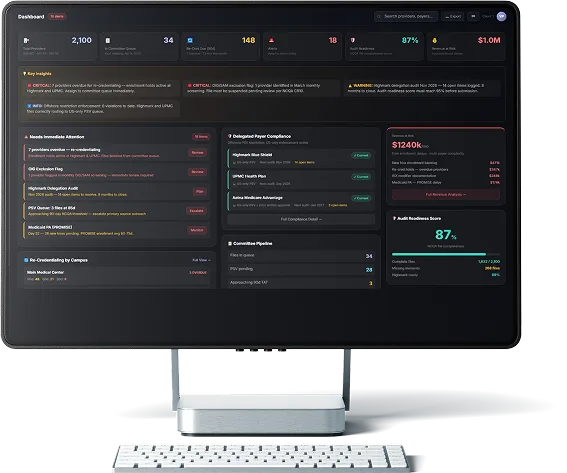
Every day a newly hired cardiologist sits uncredentialed costs roughly $10K+ per provider per day in lost revenue. For PE-backed cardiology platforms and multi-site groups scaling cardiologist count, credentialing delay — not billing — is often the biggest revenue drag. InCredibly turns credentialing from a 90–180-day black box into a 60-day forecastable pipeline.
Credentialing Timeline Forecasting
Date-certain timelines by payer and provider. Leadership plans go-live dates, not best-guesses them.
Provider Go-Live Visibility
Each cardiologist tracked through credentialing and enrollment in real time, with early alerts when timelines start to slip.
Multi-Entity, Multi-State Support
Manage credentialing across multiple sites, payers, and state regulations — essential for cardiology platforms scaling across geographies.
Revenue Readiness Tracking
Connect credentialing progress directly to revenue timing. Bottlenecks surface before they impact cash flow.
Why Cardiology Practices Choose Neolytix Over a Generalist Billing Company — or a Software-Only Tool
The cardiology billing market has two failure modes. A generalist vendor can’t hold cath lab combined coding, EP CPT families, device reporting, and NCD/LCD compliance in their head. A software-only platform sells you a dashboard but doesn’t run the cycle. Neolytix is the operating team — cardiology-trained — with the technology layer built in, not sold separately.
| Neolytix | Generalist Billing Company | Software-Only Platform | |
|---|---|---|---|
| Operating Model | Strategic partner — coding, claims, denials, AR, credentialing | Claims submission + follow-up only | Dashboards; you run the cycle |
| Cardiology Specialty Depth | Dedicated cardiology, EP, and vascular coders | Cross-trained across 5–10 specialties | Specialty-agnostic |
| Cath Lab Combined Coding | Audited on every case | Frequently undercoded | Surfaces patterns; doesn't fix them |
| EP Coding | Specialized EP coder team | Often 75–120+ days | Visibility only |
| Device Reporting | C-codes, HCPCS, invoice-pricing workflow | Often missed, revenue eaten | Tracking but no remediation team |
| NCD/LCD Compliance | Verified pre-submission | Reactive — caught at denial | References available; not enforced |
| Hospital-Based Split Billing | Professional + facility supported | Often a limitation | Doesn't differentiate |
| Multi-Sub-Specialty Governance | One model across interventional, EP, structural, vascular | Inconsistent per sub-specialty | Reporting only |
| Clean Claim Rate Target | >96% first-pass | Industry typical 85–92% (MGMA) | Reports the rate; can't move it |
| AR Days Target | Under 60 days net AR | Often 75–120+ days | Tracks the number |
Cardiology RCM Built for Every Care Model and Every Buyer Type
Cardiology groups don’t share one buyer profile. Independent practices, multi-sub-specialty groups, hospital service lines, and PE-backed platforms each read the SERP differently. Neolytix engages each against the operating model they actually need.
General & Preventive Cardiology
outpatient consults, stress testing, risk stratification
Interventional Cardiology & Cath Lab
combined diagnostic/intervention coding, IVUS, FFR, drug-eluting stent reporting
Electrophysiology (EP)
ablation, comprehensive EP studies, device implants, 3D mapping
Structural Heart & TAVR Programs
TAVR, MitraClip, Watchman; heart team documentation
Vascular Surgery & Peripheral Intervention
peripheral vascular, dialysis access, AAA repair
Cardiac Rehabilitation Programs
93797/8, G0422/3, enrollment + time tracking
Heart Failure & Advanced Cardiology
HF clinics, advanced therapies, transplant program billing
Pediatric & Congenital Cardiology
congenital heart program billing, pediatric coding nuance
Cardiothoracic Surgery
CABG, valve, thoracic procedures; surgical bundling
Cardiology Imaging — IDTF Settings
nuclear cardiology, cardiac CT, cardiac MR, echo under Medicare IDTF supplier standards
40
US states
2x
languages
Committed Milestones — Not a Vague Onboarding Promise.
Day 30
Clean claim rate at 95%+; baseline diagnostic delivered to CFO.
Day 60
AR over 90 days held under 15%; payer-specific denial trends mapped.
Day 90
Denial rate reduced 40%+ from baseline.
Day 100
Full Incredibly AI dashboards live; first quarterly business review delivered.
Day 30
Clean claim rate at 95%+; baseline diagnostic delivered to CFO.
Day 60
AR over 90 days held under 15%; payer-specific denial trends mapped.
Day 90
Denial rate reduced 40%+ from baseline.
Day 100
Full Incredibly AI dashboards live; first quarterly business review delivered.
Security-First. At Every Step.
Built for Compliance. Designed for Confidence.
Every service we deliver is built on a foundation of strict data governance and regulatory compliance. HIPAA safeguards and ISO 27001-certified security practices are embedded into how we work, not added after the fact.

Get in Touch With Us
FAQs
Frequently Asked Questions About Neolytix Cardiology & Vascular RCM
How Does Cardiology Billing Differ From Primary Care Billing?
Cardiology billing combines surgical-density CPT coding, modifier-intensive cath lab cases, payer-specific device reporting (pacemakers, ICDs, TAVR, MitraClip, Watchman, stents), heavy NCD/LCD compliance requirements, and frequent hospital-based split billing. Industry denial rates for cardiology routinely exceed primary care due to pre-authorization density and documentation complexity.
Can You Support Cath Lab Billing, Including Combined Diagnostic + Interventional Cases?
Yes. Cath lab combined-case coding — diagnostic catheterization leading directly to intervention with IVUS/FFR add-ons — is audited on every applicable case in our cardiology workflow. Coding is verified against the cath lab report at submission. Combined-case undercoding is one of the largest hidden revenue losses we find in cardiology practices.
Do You Handle Electrophysiology (EP) Billing?
Yes. Our EP coders are trained on ablation coding (93653, 93654, 93656), comprehensive EP studies (93620–93624), and device implant/revision coding. EP undercoding is one of the most common and highest-dollar revenue losses in cardiology — particularly at multi-sub-specialty groups where EP is one of several sub-specialties on staff.
Can You Support PE-backed Cardiology Platforms With Multiple Sites?
Yes. We deliver a repeatable acquisition runbook for new tuck-ins, standardized SOPs across acquired practices, board-ready reporting consistency, and a documented integration timeline. Operating Partners and platform CFOs at cardiology platforms can request a portfolio-level briefing covering integration timelines, KPIs, and sponsor/lender reporting.
Can You Bill for Cardiac Rehab, CCM, and RPM?
Yes. Cardiac rehabilitation (93797, 93798), intensive cardiac rehab (G0422, G0423), chronic care management (99490, 99439), and remote patient monitoring (99453–99458) are all revenue streams we actively enroll patients into and bill on behalf of cardiology practices. For most multi-cardiologist groups this is the single largest unrecognized revenue category.
Do You Support Hospital-based Cardiology (split billing)?
Yes. We handle both independent cardiology practice billing and hospital-based split-billing workflows (professional + facility component). For Directors of Cardiology Service Line, we surface service-line-level economics that don’t get absorbed into hospital outpatient billing — visible to the service line CFO, not buried.
How Do You Handle Medicare NCD/LCD Compliance for Cardiology Under the New CMS PA Reform Rule?
Our pre-authorization and coding teams verify NCD and LCD coverage criteria before submission for cardiac imaging, EP procedures, device implants, and interventional cases. Workflows are built around CMS Prior Authorization Reform (Sept 2025) — 7-day decision windows and mandatory electronic PA. We submit ePA on every covered case for Watchman, TAVR, and ICD implants.
Do You Support IDTF Billing for Cardiology Imaging?
Yes. Independent Diagnostic Testing Facilities (IDTFs) operating nuclear cardiology, cardiac CT, cardiac MR, and echocardiography have distinct Medicare supplier standards. Our team is configured for IDTF billing as a separate workflow within the cardiology engagement.
Related Articles




See Where Your Cardiology Revenue Is Leaking — In One Week, Free
The free Cardiology Revenue Audit gives you a written diagnostic of cath lab undercoding, device reporting gaps, EP coding errors, NCD/LCD coverage misses, and CCM/RPM enrollment opportunities — built from your own claims data. No commitment, no engagement required to see the findings.
Response within 1 business day · HIPAA-compliant onboarding · ISO 27001 certified · Trusted by 300+ healthcare organizations nationwide



